Introduction
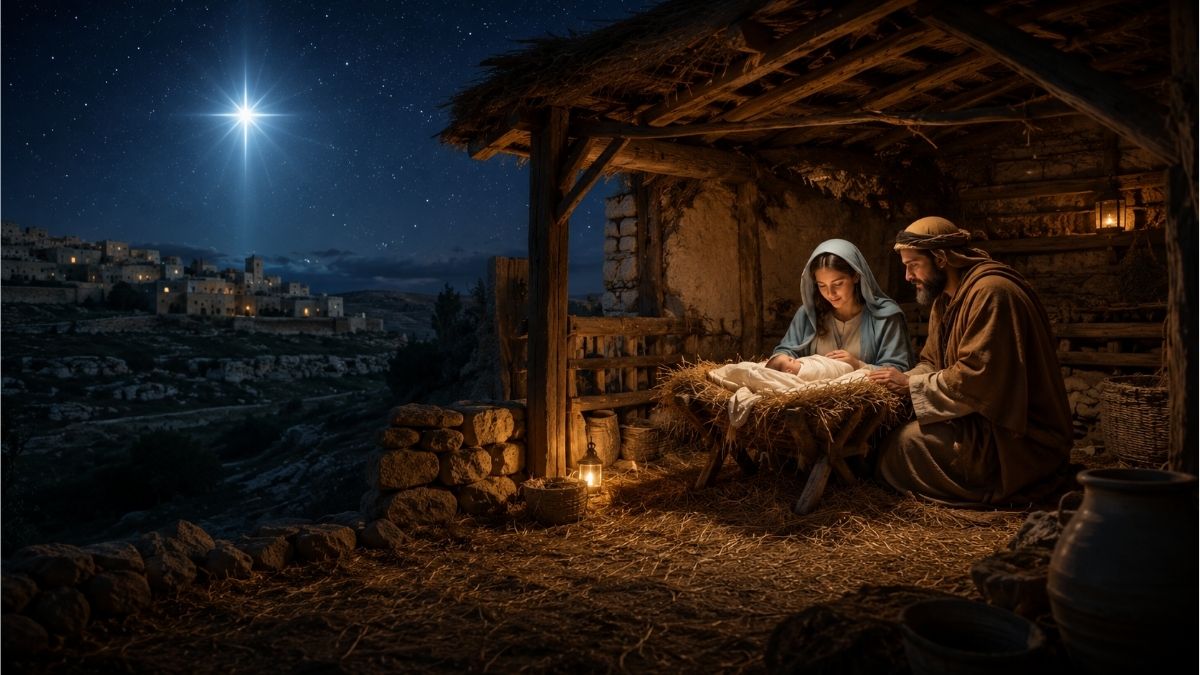
Bethlehem was crowded enough for a journeying couple to struggle for suitable lodging, yet quiet enough for most of the town to sleep through the event Christians would remember for centuries. Mary gave birth to Jesus, wrapped Him, and laid Him in a manger. Outside the town, shepherds heard an angel announce a Savior and went to see the child for themselves.
These 19 historical selections are Christian poems about what happened in Bethlehem: Jesus’ birth, Mary and Joseph, the manger, angels, shepherds, the Star, the Wise Men, prophecy, humility, peace, and the meaning of the Nativity. Readers looking for broader devotional collections can also visit the Christian Poems page.
Each poem includes a short summary, Christian meaning and reflection, main themes, a biblical connection, and a suggested best use. Detailed analysis appears only where it adds genuine value. One timeline detail also matters: Luke 2 places the shepherds at the newborn child’s manger, while Matthew 2 describes the Magi in a later part of the infancy narrative. Traditional poetry often combines both scenes into one Christmas picture, so the reflections identify that distinction where relevant.
Public-Domain Christian Nativity Poetry
Christian Poems About What Happened in Bethlehem
Christian Poems About JesusO Little Town of Bethlehem
O little town of Bethlehem,
How still we see thee lie!
Above thy deep and dreamless sleep
The silent stars go by;
Yet in thy dark streets shineth
The everlasting Light;
The hopes and fears of all the years
Are met in thee to-night.
For Christ is born of Mary,
And, gathered all above,
While mortals sleep, the angels keep
Their watch of wondering love.
O morning stars, together
Proclaim the holy birth!
And praises sing to God the King,
And peace to men on earth.
How silently, how silently,
The wondrous gift is given!
So God imparts to human hearts
The blessings of His heaven.
No ear may hear His coming,
But in this world of sin,
Where meek souls will receive Him still,
The dear Christ enters in.
O holy Child of Bethlehem!
Descend to us, we pray;
Cast out our sin, and enter in,
Be born in us to-day.
We hear the Christmas angels
The great glad tidings tell;
Oh, come to us, abide with us,
Our Lord Emmanuel!
Overview Short Summary
Bethlehem sleeps quietly while Christ is born, angels watch, and the small town becomes the meeting place of humanity’s hopes and fears.
Faith Reflection Christian Meaning and Reflection
The poem explains what happened in Bethlehem by joining the historical birth of Jesus with its spiritual meaning. The child is presented as Emmanuel, the everlasting Light who comes quietly into a dark world.
Core Ideas Main Themes
- Bethlehem: The small town becomes central to the Nativity story.
- Incarnation: Christ is born of Mary and enters human life.
- Peace and hope: The birth is announced as good news for the world.
Scriptural Context Biblical Connection
Luke 2:1–20 records Jesus’ birth, the manger, angels, and shepherds. Micah 5:2 identifies Bethlehem as the promised ruler’s birthplace.
Reader Application Best Use
Ideal for Christmas worship, church programs, family readings, Bethlehem lessons, or an opening poem for a Nativity collection.
Close Reading Stanza-by-Stanza Explanation
Stanza 1
Bethlehem’s stillness is contrasted with the everlasting Light.
Stanza 2
Mary, angels, praise, and peace establish the Nativity setting.
Stanzas 3–4
The historical event becomes a prayer for Christ to enter human hearts.
Poetic Technique Imagery and Literary Devices
Contrast, light imagery, personification of Bethlehem, repetition, and prayerful direct address make the poem both narrative and devotional.
The Shepherds
O than the fairest day, thrice fairer night!
Night to blest days in which a sun doth rise
Of which that golden eye which clears the skies
Is but a sparkling ray, a shadow-light!
And blessed ye, in silly pastor’s sight,
Mild creatures, in whose warm crib now lies
That heaven-sent youngling, holy-maid-born wight,
Midst, end, beginning of our prophecies!
Blest cottage that hath flowers in winter spread,
Though withered—blessed grass that hath the grace
To deck and be a carpet to that place!
Thus sang, unto the sounds of oaten reed,
Before the Babe, the shepherds bowed on knees;
And springs ran nectar, honey dropped from trees.
Overview Short Summary
The shepherds praise the holy night, the humble shelter, and the infant who fulfills ancient prophecy.
Faith Reflection Christian Meaning and Reflection
The poem emphasizes the reversal at Bethlehem: divine glory is found in a crib, on grass, among shepherds and animals rather than in a royal palace.
Core Ideas Main Themes
- Shepherds: Ordinary workers become early witnesses.
- Humble glory: The birthplace is poor yet spiritually radiant.
- Prophecy: The child is described as the fulfillment of expectation.
Scriptural Context Biblical Connection
Luke 2:8–20 describes the shepherds hearing the angelic message and finding Mary, Joseph, and the baby.
Reader Application Best Use
Suitable for a short Bethlehem reading, shepherd-themed service, Sunday school, or a reflection on humility.
A Christmas Carol
“What means this glory round our feet,”
The Magi mused, “more bright than morn?”
And voices chanted clear and sweet,
“To-day the Prince of Peace is born!”
“What means that star,” the Shepherds said,
“That brightens through the rocky glen?”
And angels, answering overhead,
Sang, “Peace on earth, good-will to men!”
‘Tis eighteen hundred years and more
Since those sweet oracles were dumb;
We wait for Him, like them of yore;
Alas, He seems so slow to come!
But it was said, in words of gold,
No time or sorrow e’er shall dim,
That little children might be bold
In perfect trust to come to Him.
All round about our feet shall shine
A light like that the wise men saw,
If we our loving wills incline
To that sweet Life which is the Law.
So shall we learn to understand
The simple faith of shepherds then,
And, clasping kindly hand in hand,
Sing, “Peace on earth, good-will to men!”
But they who do their souls no wrong,
But keep at eve the faith of morn,
Shall daily hear the angel-song,
“To-day the Prince of Peace is born!”
Overview Short Summary
Magi, shepherds, the star, and angels lead into a call to live the Bethlehem message through trust, love, and peace.
Faith Reflection Christian Meaning and Reflection
The poem does more than retell the Nativity. It asks readers to carry Bethlehem’s peace into daily relationships and childlike trust.
Core Ideas Main Themes
- Prince of Peace: Jesus’ birth is connected with reconciliation.
- Star and angels: The signs point toward the newborn Christ.
- Living the message: Bethlehem’s meaning is expressed through love and goodwill.
Scriptural Context Biblical Connection
Luke 2:14 records the angelic praise and message of peace. Matthew 2:1–12 tells of the Magi following the star.
Reader Application Best Use
Useful for Christmas peace services, family readings, church recitations, or a Nativity lesson connecting belief with conduct.
Close Reading Stanza-by-Stanza Explanation
Opening
Magi, shepherds, star, and angels recreate the Nativity scene.
Middle
The poem turns from history to patient Christian hope.
Conclusion
The angel song becomes a daily call to peace and goodwill.
Brightest and Best of the Sons of the Morning
Brightest and best of the Sons of the morning!
Dawn on our darkness and lend us thine aid!
Star of the East, the horizon adorning,
Guide where our Infant Redeemer is laid!
Cold on His cradle the dewdrops are shining,
Low lies His head with the beasts of the stall;
Angels adore Him in slumber reclining,
Maker and Monarch and Saviour of all!
Say, shall we yield Him, in costly devotion,
Odors of Edom and offerings divine?
Gems of the mountain and pearls of the ocean,
Myrrh from the forest, or gold from the mine?
Vainly we offer each ample oblation;
Vainly with gifts would His favor secure:
Richer by far is the heart’s adoration;
Dearer to God are the prayers of the poor.
Brightest and best of the Sons of the morning!
Dawn on our darkness and lend us thine aid!
Star of the East, the horizon adorning,
Guide where our Infant Redeemer is laid!
Overview Short Summary
The Star of the East leads worshippers toward the infant Redeemer, whose humble cradle contrasts with His divine kingship.
Faith Reflection Christian Meaning and Reflection
The poem shifts attention from expensive gifts to sincere worship. Bethlehem’s King is honored most deeply through adoration rather than display.
Core Ideas Main Themes
- Star of Bethlehem: The star guides seekers toward Christ.
- Humble kingship: The Maker lies among the animals.
- True worship: The heart matters more than costly gifts.
Scriptural Context Biblical Connection
Matthew 2:1–11 describes the Magi, the star, and their gifts. The poem also reflects the humility of Luke 2:7.
Reader Application Best Use
Excellent for Epiphany, Star of Bethlehem readings, Magi programs, or a reflection on meaningful Christmas gifts.
Poetic Technique Imagery and Literary Devices
Refrain, apostrophe to the star, contrast between royal identity and humble cradle, and rhetorical questions shape the hymn.
God Rest Ye, Merry Gentlemen
God rest ye, merry gentlemen; let nothing you dismay,
For Jesus Christ, our Saviour, was born on Christmas-day.
The dawn rose red o’er Bethlehem, the stars shone through the gray,
When Jesus Christ, our Saviour, was born on Christmas-day.
God rest ye, little children; let nothing you affright,
For Jesus Christ, your Saviour, was born this happy night;
Along the hills of Galilee the white flocks sleeping lay,
When Christ, the child of Nazareth, was born on Christmas-day.
God rest ye, all good Christians; upon this blessed morn
The Lord of all good Christians was of a woman born:
Now all your sorrows He doth heal, your sins He takes away;
For Jesus Christ, our Saviour, was born on Christmas-day.
Overview Short Summary
The poem announces the Savior’s birth as a reason for courage, comfort, healing, and joy.
Faith Reflection Christian Meaning and Reflection
Bethlehem is presented as good news for frightened and sorrowful people. The birth points toward Christ’s saving mission rather than remaining a sentimental scene.
Core Ideas Main Themes
- Good news: The Nativity answers fear with joy.
- Savior: The child’s mission is connected with healing and forgiveness.
- Bethlehem dawn: Light imagery marks the new beginning.
Scriptural Context Biblical Connection
Luke 2:10–11 announces good news of great joy and identifies the newborn child as Savior and Christ.
Reader Application Best Use
Suitable for congregational reading, children’s Christmas programs, comfort-themed services, or a short Savior-born-in-Bethlehem poem.
Continue Reading
Related Poems & Articles
More selected reading from Christian Poems About Jesus.