
Introduction
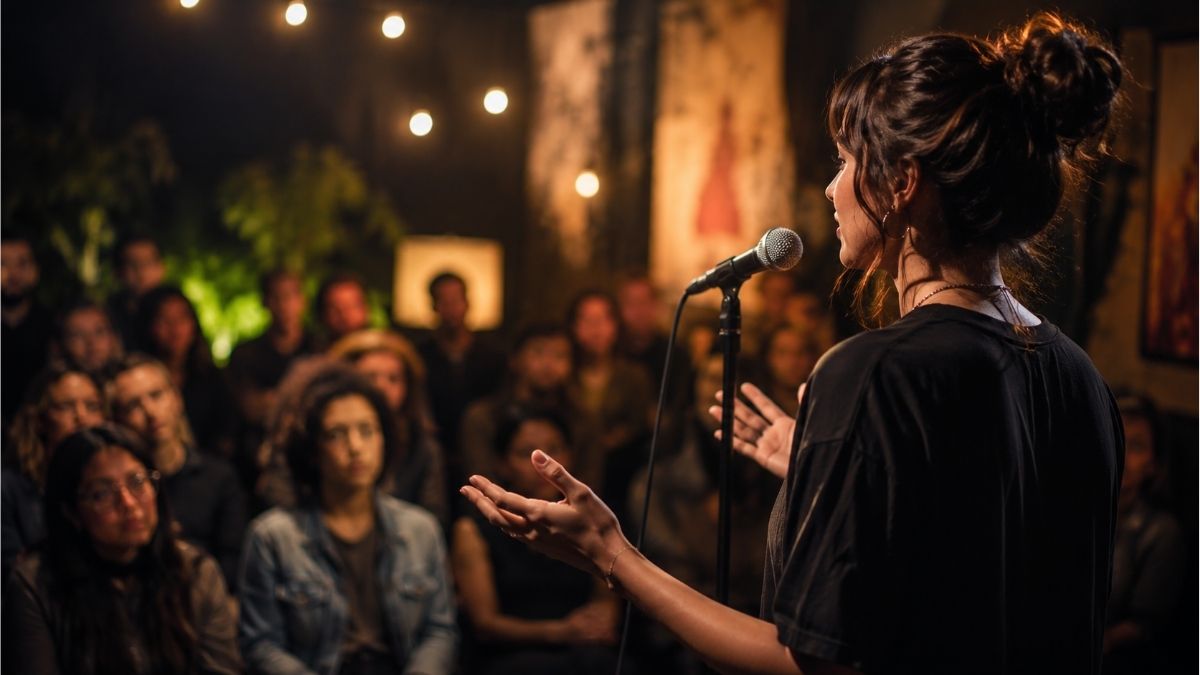
Spoken word poetry is poetry written for the voice. It becomes alive through pace, pauses, rhythm, repeated sounds, direct address, and emotional delivery. A spoken word poem can be soft, urgent, angry, funny, personal, political, or deeply reflective, but it should always feel like someone is speaking with purpose.
This collection focuses on spoken word poetry examples that are safe to read, study, and perform. You will find short spoken word poems, spoken word poetry for students, performance-friendly classics, poems about identity, courage, love, society, grief, hope, and self-belief, plus simple notes on meaning and delivery. If you enjoy poems that feel powerful when spoken aloud, you may also like exploring Inspirational Poems for more meaningful reading.
Not every poem below is a modern stage or slam poem. Instead, these are real poems with qualities people often look for when they search for spoken word poetry in English: strong voice, clear emotion, repetition, storytelling, dramatic address, musical sound, and lines that work well in classroom readings, poetry assignments, and live performance.
Poetry & Analysis
Selected Poems
Inspirational PoemsInvictus
Out of the night that covers me,
Black as the pit from pole to pole,
I thank whatever gods may be
For my unconquerable soul.
In the fell clutch of circumstance
I have not winced nor cried aloud.
Under the bludgeonings of chance
My head is bloody, but unbowed.
Beyond this place of wrath and tears
Looms but the Horror of the shade,
And yet the menace of the years
Finds and shall find me unafraid.
It matters not how strait the gate,
How charged with punishments the scroll,
I am the master of my fate,
I am the captain of my soul.
Overview Short Summary
The speaker faces darkness, pain, and pressure, but refuses to give up control of the inner self.
Performance Note Why It Works as Spoken Word
This is a strong short spoken word poetry example because every stanza builds toward a final declaration. Deliver it slowly and let the last two lines sound firm, not rushed.
Core Ideas Main Themes
- Courage: A key idea that supports the poem’s spoken word impact.
- Self-belief: A key idea that supports the poem’s spoken word impact.
- Survival: A key idea that supports the poem’s spoken word impact.
If—
If you can keep your head when all about you
Are losing theirs and blaming it on you,
If you can trust yourself when all men doubt you,
But make allowance for their doubting too;
If you can wait and not be tired by waiting,
Or being lied about, don’t deal in lies,
Or being hated, don’t give way to hating,
And yet don’t look too good, nor talk too wise:
If you can dream—and not make dreams your master;
If you can think—and not make thoughts your aim,
If you can meet with Triumph and Disaster
And treat those two impostors just the same;
If you can bear to hear the truth you’ve spoken
Twisted by knaves to make a trap for fools,
Or watch the things you gave your life to, broken,
And stoop and build ’em up with worn-out tools:
If you can make one heap of all your winnings
And risk it on one turn of pitch-and-toss,
And lose, and start again at your beginnings
And never breathe a word about your loss;
If you can force your heart and nerve and sinew
To serve your turn long after they are gone,
And so hold on when there is nothing in you
Except the Will which says to them: ‘Hold on!’
If you can talk with crowds and keep your virtue,
Or walk with Kings—nor lose the common touch,
If neither foes nor loving friends can hurt you,
If all men count with you, but none too much;
If you can fill the unforgiving minute
With sixty seconds’ worth of distance run,
Yours is the Earth and everything that’s in it,
And—which is more—you’ll be a Man, my son!
Overview Short Summary
The poem gives advice about patience, discipline, emotional balance, humility, and courage.
Performance Note Why It Works as Spoken Word
Read it like direct advice to one listener. The repeated ‘If you can’ pattern makes it useful for spoken word poetry for students and classroom recitation.
Core Ideas Main Themes
- Character: A key idea that supports the poem’s spoken word impact.
- Patience: A key idea that supports the poem’s spoken word impact.
- Self-control: A key idea that supports the poem’s spoken word impact.
If We Must Die
If we must die—let it not be like hogs
Hunted and penned in an inglorious spot,
While round us bark the mad and hungry dogs,
Making their mock at our accursed lot.
If we must die—oh, let us nobly die,
So that our precious blood may not be shed
In vain; then even the monsters we defy
Shall be constrained to honor us though dead!
Oh, Kinsmen! We must meet the common foe;
Though far outnumbered, let us show us brave,
And for their thousand blows deal one deathblow!
What though before us lies the open grave?
Like men we’ll face the murderous, cowardly pack,
Pressed to the wall, dying, but fighting back!
Overview Short Summary
The speaker calls on a threatened community to face danger with dignity, unity, and courage.
Performance Note Why It Works as Spoken Word
This poem works like a public speech. Use rising intensity, clear pauses after repeated lines, and a strong final voice.
Core Ideas Main Themes
- Resistance: A key idea that supports the poem’s spoken word impact.
- Dignity: A key idea that supports the poem’s spoken word impact.
- Collective courage: A key idea that supports the poem’s spoken word impact.
We Wear the Mask
We wear the mask that grins and lies,
It hides our cheeks and shades our eyes,—
This debt we pay to human guile;
With torn and bleeding hearts we smile,
And mouth with myriad subtleties.
Why should the world be over-wise,
In counting all our tears and sighs?
Nay, let them only see us, while
We wear the mask.
We smile, but, O great Christ, our cries
To thee from tortured souls arise.
We sing, but oh the clay is vile
Beneath our feet, and long the mile;
But let the world dream otherwise,
We wear the mask!
Overview Short Summary
The poem shows the pain of hiding suffering behind a public face that appears calm or cheerful.
Performance Note Why It Works as Spoken Word
This is powerful spoken word poetry about identity because the repeated phrase can be delivered as confession, protest, and truth at the same time.
Core Ideas Main Themes
- Identity: A key idea that supports the poem’s spoken word impact.
- Hidden pain: A key idea that supports the poem’s spoken word impact.
- Social pressure: A key idea that supports the poem’s spoken word impact.
Sympathy
I know what the caged bird feels, alas!
When the sun is bright on the upland slopes;
When the wind stirs soft through the springing grass,
And the river flows like a stream of glass;
When the first bird sings and the first bud opes,
And the faint perfume from its chalice steals—
I know what the caged bird feels!
I know why the caged bird beats his wing
Till its blood is red on the cruel bars;
For he must fly back to his perch and cling
When he fain would be on the bough a-swing;
And a pain still throbs in the old, old scars
And they pulse again with a keener sting—
I know why he beats his wing!
I know why the caged bird sings, ah me,
When his wing is bruised and his bosom sore,—
When he beats his bars and he would be free;
It is not a carol of joy or glee,
But a prayer that he sends from his heart’s deep core,
But a plea, that upward to Heaven he flings—
I know why the caged bird sings!
Overview Short Summary
The speaker compares deep human longing for freedom with the pain of a caged bird.
Performance Note Why It Works as Spoken Word
Use a restrained, emotional delivery. The repeated ‘I know’ gives the poem a spoken-word feeling of witness and lived understanding.
Core Ideas Main Themes
- Freedom: A key idea that supports the poem’s spoken word impact.
- Pain: A key idea that supports the poem’s spoken word impact.
- Empathy: A key idea that supports the poem’s spoken word impact.
Continue Reading
Related Poems & Articles
More selected reading from Inspirational Poems.



Comments are closed.