
Introduction
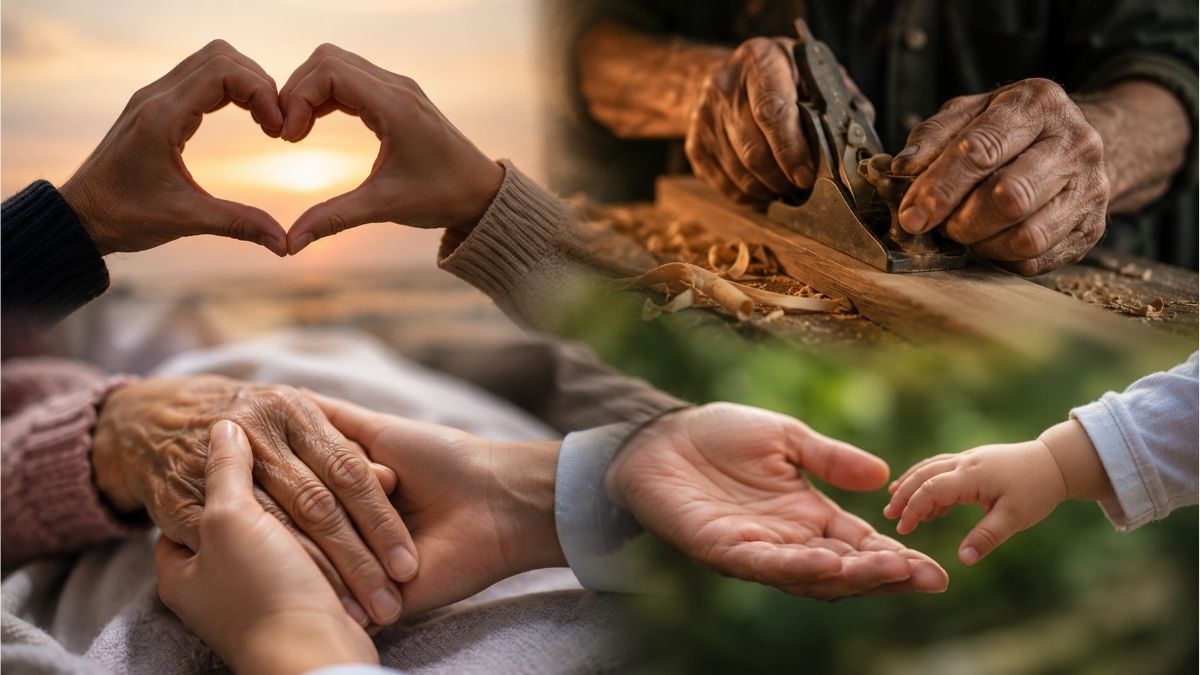
Hands appear in poetry as more than a part of the body. They hold, work, bless, comfort, create, lose, remember, and reach for love. That is why poems about hands can feel deeply personal: a single palm, touch, clasp, or working hand can carry a whole story of care, labor, grief, childhood, faith, or desire.
This collection brings together classic poems about hands, touch, love, work, mother’s hands, little hands, helping hands, old hands, and memory. Readers will find poems where hands become symbols of tenderness, responsibility, grief, creativity, and human connection. For more curated poetry reading, you can also explore Featured Poems.
Poetry & Analysis
Selected Poems
Inspirational PoemsYour Hands
I love your hands:
They are big hands, firm hands, gentle hands;
Hair grows on the back near the wrist . . . .
I have seen the nails broken and stained
From hard work.
And yet, when you touch me,
I grow small . . . . . . . and quiet . . . . . .
. . . . . . . . . And happy . . . . . . . .
If I might only grow small enough
To curl up into the hollow of your palm,
Your left palm,
Curl up, lie close and cling,
So that I might know myself always there,
. . . . . . . Even if you forgot.
Overview Short Summary
This intimate love poem turns hands into signs of work, tenderness, safety, and closeness. It fits searches for poems about hands and love because the speaker sees the beloved’s hands as both strong and gentle.
Core Ideas Main Themes
- Love and touch: The poem connects affection with the physical nearness of hands.
- Work and tenderness: Broken and stained nails suggest labor, while the touch creates comfort.
- Safety: The palm becomes an imagined shelter for the speaker.
Emotional Effect Tone and Mood
The tone is affectionate, vulnerable, and quietly sensual; the mood is tender and protected.
Craft Literary Devices
- Imagery: The poem uses concrete details such as nails, wrist, and palm.
- Repetition: The repeated word “hands” keeps the body image central.
The Hand That Rocks the Cradle
Blessings on the hand of women!
Angels guard its strength and grace.
In the palace, cottage, hovel,
Oh, no matter where the place;
Would that never storms assailed it,
Rainbows ever gently curled,
For the hand that rocks the cradle
Is the hand that rules the world.
Infancy’s the tender fountain,
Power may with beauty flow,
Mothers first to guide the streamlets,
From them souls unresting grow—
Grow on for the good or evil,
Sunshine streamed or evil hurled,
For the hand that rocks the cradle
Is the hand that rules the world.
Woman, how divine your mission,
Here upon our natal sod;
Keep—oh, keep the young heart open
Always to the breath of God!
All true trophies of the ages
Are from mother-love impearled,
For the hand that rocks the cradle
Is the hand that rules the world.
Blessings on the hand of women!
Fathers, sons, and daughters cry,
And the sacred song is mingled
With the worship in the sky—
Mingles where no tempest darkens,
Rainbows evermore are hurled;
For the hand that rocks the cradle
Is the hand that rules the world.
Overview Short Summary
The poem praises motherhood by making the hand that rocks a cradle a symbol of influence, care, and moral formation. It is useful for searches around mother’s hands poems and poems about hands and care.
Core Ideas Main Themes
- Motherhood: The mother’s hand represents nurture and early guidance.
- Influence: The refrain argues that private care shapes the wider world.
- Protection: The poem blesses the hand that guards childhood.
Emotional Effect Tone and Mood
The tone is reverent and celebratory, creating a mood of gratitude toward maternal care.
Craft Literary Devices
- Refrain: The repeated closing line gives the poem its memorable force.
- Symbolism: The cradle-hand symbolizes motherhood’s lasting power.
Beautiful Hands
Such beautiful, beautiful hands!
They’re neither white nor small;
And you, I know, would scarcely think
That they were fair at all.
I’ve looked on hands whose form and hue
A sculptor’s dream might be,
Yet are these aged, wrinkled hands
Most beautiful to me.
Such beautiful, beautiful hands!
Though heart were weary and sad,
Those patient hands kept toiling on,
That children might be glad.
I almost weep, as looking back
To childhood’s distant day,
I think how these hands rested not
When mine were at their play.
Such beautiful, beautiful hands!
They’re growing feeble now,
For time and pain have left their mark
On hand and heart and brow.
Alas! alas! the nearing time—
And the sad, sad day to me,
When ‘neath the daisies, out of sight,
These hands must folded be.
But oh! beyond this shadow-land,
Where all is bright and fair,
I know full well these dear old hands
Will palms of victory bear.
Where crystal streams through endless years
Flow over golden sands,
And where the old grow young again,
I’ll clasp my mother’s hands.
Overview Short Summary
This poem honors a mother’s aged hands as signs of labor, sacrifice, and love. It directly supports keywords such as mother’s hands poem, poems about mom’s hands, and poems about old hands.
Core Ideas Main Themes
- Mother’s love: The speaker sees beauty in hands shaped by care.
- Sacrifice: The hands worked so children could be happy.
- Memory: The poem looks back from adulthood to childhood.
Emotional Effect Tone and Mood
The tone is grateful and emotional; the mood moves from tenderness to grief and hope.
Craft Literary Devices
- Contrast: Physical age contrasts with spiritual beauty.
- Symbolism: The mother’s hands symbolize lifelong service.
The Village Blacksmith
Under a spreading chestnut-tree
The village smithy stands;
The smith, a mighty man is he,
With large and sinewy hands;
And the muscles of his brawny arms
Are strong as iron bands.
His hair is crisp, and black and long,
His face is like the tan;
His brow is wet with honest sweat,
He earns whate’er he can,
And looks the whole world in the face.
For he owes not any man.
Week in, week out, from morn till night,
You can hear his bellows blow;
You can hear him swing his heavy sledge.
With measured beat and slow,
Like a sexton ringing the village bell,
When the evening sun is low.
And children coming home from school
Look in at the open door;
They love to see the flaming forge,
And hear the bellows roar.
And catch the burning sparks that fly
Like chaff from a threshing-floor.
He goes on Sunday to the church.
And sits among his boys;
He hears the parson pray and preach,
He hears his daughter’s voice.
Singing in the village choir.
And it makes his heart rejoice.
It sounds to him like her mother’s voice,
Singing in Paradise!
He needs must think of her once more.
How in the grave she lies;
And with his hard, rough hand he wipes
A tear out of his eyes.
Toiling—rejoicing—sorrowing,
Onward through life he goes;
Each morning sees some task begin,
Each evening sees it close;
Something attempted, something done,
Has earned a night’s repose.
Thanks, thanks to thee, my worthy friend,
For the lesson thou hast taught!
Thus at the flaming forge of life
Our fortunes must be wrought;
Thus on its sounding anvil shaped
Each burning deed and thought.
Overview Short Summary
The poem presents working hands as signs of strength, honesty, grief, and discipline. It is one of the best classic poems for keywords like working hands poem and poems about hands and work.
Core Ideas Main Themes
- Honest work: The blacksmith’s hands represent daily labor.
- Dignity: The speaker respects the worker’s independence.
- Tenderness: The rough hand wiping a tear shows emotional depth.
Emotional Effect Tone and Mood
The tone is admiring and warm; the mood is steady, respectful, and human.
Craft Literary Devices
- Simile: The muscles are compared to iron bands.
- Symbolism: The forge becomes a symbol of life and character.
The Song of the Shirt
With fingers weary and worn,
With eyelids heavy and red,
A woman sat in unwomanly rags,
Plying her needle and thread—
Stitch! stitch! stitch!
In poverty, hunger, and dirt,
And still with a voice of dolorous pitch
She sang the “Song of the Shirt.”
“Work! work! work!
While the cock is crowing aloof!
And work—work—work,
Till the stars shine through the roof!
It’s O! to be a slave
Along with the barbarous Turk,
Where woman has never a soul to save,
If this is Christian work!
“Work—work—work,
Till the brain begins to swim;
Work—work—work,
Till the eyes are heavy and dim!
Seam, and gusset, and band,
Band, and gusset, and seam,
Till over the buttons I fall asleep,
And sew them on in a dream!
“O, men, with sisters dear!
O, men, with mothers and wives!
It is not linen you’re wearing out,
But human creatures’ lives!
Stitch—stitch—stitch,
In poverty, hunger and dirt,
Sewing at once, with a double thread,
A Shroud as well as a Shirt.
“But why do I talk of death?
That phantom of grisly bone,
I hardly fear his terrible shape,
It seems so like my own—
It seems so like my own,
Because of the fasts I keep;
Oh, God! that bread should be so dear.
And flesh and blood so cheap!
“Work—work—work!
My labour never flags;
And what are its wages? A bed of straw,
A crust of bread—and rags.
That shattered roof—this naked floor—
A table—a broken chair—
And a wall so blank, my shadow I thank
For sometimes falling there!
“Work—work—work!
From weary chime to chime,
Work—work—work,
As prisoners work for crime!
Band, and gusset, and seam,
Seam, and gusset, and band,
Till the heart is sick, and the brain benumbed,
As well as the weary hand.
“Work—work—work,
In the dull December light,
And work—work—work,
When the weather is warm and bright—
While underneath the eaves
The brooding swallows cling
As if to show me their sunny backs
And twit me with the spring.
“O! but to breathe the breath
Of the cowslip and primrose sweet—
With the sky above my head,
And the grass beneath my feet;
For only one short hour
To feel as I used to feel,
Before I knew the woes of want
And the walk that costs a meal!
“O! but for one short hour!
A respite however brief!
No blessed leisure for Love or hope,
But only time for grief!
A little weeping would ease my heart,
But in their briny bed
My tears must stop, for every drop
Hinders needle and thread!”
With fingers weary and worn,
With eyelids heavy and red,
A woman sat in unwomanly rags,
Plying her needle and thread—
Stitch! stitch! stitch!
In poverty, hunger, and dirt,
And still with a voice of dolorous pitch,—
Would that its tone could reach the Rich!—
She sang this “Song of the Shirt!”
Overview Short Summary
This labor poem focuses on exhausted fingers and a weary hand to expose poverty and exploitation. It supports searches for working hands poems and poems about hands and work.
Core Ideas Main Themes
- Labor and poverty: Hands are shown as overworked instruments of survival.
- Social criticism: The poem asks readers to see the human cost behind clothing.
- Exhaustion: Repetition makes the labor feel endless.
Emotional Effect Tone and Mood
The tone is sorrowful and urgent; the mood is heavy, compassionate, and reform-minded.
Craft Literary Devices
- Repetition: “Work—work—work” imitates relentless labor.
- Metaphor: The shirt becomes linked with a shroud, connecting work and death.
Continue Reading
Related Poems & Articles
More selected reading from Inspirational Poems.



Comments are closed.