
Poetry & Analysis
Selected Poems
Inspirational PoemsA Noiseless Patient Spider
A noiseless patient spider,
I mark’d where on a little promontory it stood isolated,
Mark’d how to explore the vacant vast surrounding,
It launch’d forth filament, filament, filament, out of itself,
Ever unreeling them, ever tirelessly speeding them.
And you O my soul where you stand,
Surrounded, detached, in measureless oceans of space,
Ceaselessly musing, venturing, throwing, seeking the spheres to connect them,
Till the bridge you will need be form’d, till the ductile anchor hold,
Till the gossamer thread you fling catch somewhere, O my soul.
Overview Short Summary
Whitman watches a spider sending out filaments into empty space and sees it as an image of the soul searching for connection. The web becomes a metaphor for spiritual and emotional reaching.
Core Ideas Main Themes
- Loneliness and connection: The spider and the soul are both isolated but active.
- Patience: The spider keeps unreeling threads until one catches.
- Spiritual searching: The soul seeks a bridge across “measureless oceans of space.”
Craft Literary Devices
- Extended metaphor: The spider’s web-making represents the soul’s search for connection.
- Repetition: “Filament, filament, filament” emphasizes effort and persistence.
- Apostrophe: The speaker directly addresses the soul in the second stanza.
The Spider and the Fly
“Will you walk into my parlour?” said the Spider to the Fly,
“‘Tis the prettiest little parlour that ever you did spy;
The way into my parlour is up a winding stair,
And I have many curious things to show you when you are there.”
“Oh no, no,” said the little Fly, “to ask me is in vain,
For who goes up your winding stair can ne’er come down again.”
“I’m sure you must be weary, dear, with soaring up so high;
Will you rest upon my little bed?” said the Spider to the Fly.
“There are pretty curtains drawn around; the sheets are fine and thin,
And if you like to rest awhile, I’ll snugly tuck you in!”
“Oh no, no,” said the little Fly, “for I’ve often heard it said,
They never, never wake again, who sleep upon your bed!”
Said the cunning Spider to the Fly, “Dear friend, what can I do,
To prove the warm affection I’ve always felt for you?
I have within my pantry, good store of all that’s nice;
I’m sure you’re very welcome—will you please to take a slice?”
“Oh no, no,” said the little Fly, “kind sir, that cannot be,
I’ve heard what’s in your pantry, and I do not wish to see!”
“Sweet creature!” said the Spider, “you’re witty and you’re wise,
How handsome are your gauzy wings, how brilliant are your eyes!
I have a little looking-glass upon my parlour-shelf,
If you’ll step in one moment, dear, you shall behold yourself.”
“I thank you, gentle sir,” she said, “for what you’re pleased to say,
And bidding you good morning now, I’ll call another day.”
The Spider turned him round about, and went into his den,
For well he knew the silly Fly would soon come back again;
So he wove a subtle web, in a little corner sly,
And set his table ready to dine upon the Fly.
Then he came out to his door again, and merrily did sing,
“Come hither, hither, pretty Fly, with the pearl and silver wing;
Your robes are green and purple—there’s a crest upon your head;
Your eyes are like the diamond bright, but mine are dull as lead!”
Alas, alas! how very soon this silly little Fly,
Hearing his wily, flattering words, came slowly flitting by;
With buzzing wings she hung aloft, then near and nearer drew,
Thinking only of her brilliant eyes, and green and purple hue;
Thinking only of her crested head—poor foolish thing! At last,
Up jumped the cunning Spider, and fiercely held her fast.
He dragged her up his winding stair, into his dismal den,
Within his little parlour—but she ne’er came out again!
And now dear little children, who may this story read,
To idle, silly, flattering words, I pray you ne’er give heed:
Unto an evil counsellor, close heart, and ear, and eye,
And take a lesson from this tale of the Spider and the Fly.
Overview Short Summary
A clever spider repeatedly tries to lure a fly into his parlour. The fly resists at first, but eventually falls for flattery and is caught in the spider’s web.
Core Ideas Main Themes
- Flattery and danger: The spider’s compliments are traps disguised as kindness.
- Temptation: The fly is drawn in by vanity rather than need.
- Moral caution: The final stanza directly warns readers to avoid deceptive counsellors.
Style Tone and Literary Devices
The tone is playful on the surface but cautionary underneath. The poem uses dialogue, repetition, rhyme, personification, and allegory to turn a simple spider web into a moral lesson.
The Thread of Life
The irresponsive silence of the land,
The irresponsive sounding of the sea,
Speak both one message of one sense to me:—
Aloof, aloof, we stand aloof, so stand
Thou too aloof bound with the flawless band
Of inner solitude; we bind not thee;
But who from thy self-chain shall set thee free?
What heart shall touch thy heart? what hand thy hand?—
And I am sometimes proud and sometimes meek,
And sometimes I remember days of old
When fellowship seemed not so far to seek
And all the world and I seemed much less cold,
And at the rainbow’s foot lay surely gold,
And hope felt strong and life itself not weak.
Thus am I mine own prison. Everything
Around me free and sunny and at ease:
Or if in shadow, in a shade of trees
Which the sun kisses, where the gay birds sing
And where all winds make various murmuring;
Where bees are found, with honey for the bees;
Where sounds are music, and where silences
Are music of an unlike fashioning.
Then gaze I at the merrymaking crew,
And smile a moment and a moment sigh
Thinking: Why can I not rejoice with you?
But soon I put the foolish fancy by:
I am not what I have nor what I do;
But what I was I am, I am even I.
Therefore myself is that one only thing
I hold to use or waste, to keep or give;
My sole possession every day I live,
And still mine own despite Time’s winnowing.
Ever mine own, while moons and seasons bring
From crudeness ripeness mellow and sanative;
Ever mine own, till Death shall ply his sieve;
And still mine own, when saints break grave and sing.
And this myself as king unto my King
I give, to Him Who gave Himself for me;
Who gives Himself to me, and bids me sing
A sweet new song of His redeemed set free;
He bids me sing: O death, where is thy sting?
And sing: O grave, where is thy victory?
Overview Short Summary
Rossetti’s poem explores inner solitude, selfhood, and spiritual surrender. The “thread of life” is not a visible loom image here, but the title frames the self as something held, tested, and finally offered to God.
Core Ideas Main Themes
- Inner solitude: The speaker feels separate from others and from the visible world.
- Self-possession: The speaker recognizes the self as the one thing truly owned.
- Spiritual surrender: The poem ends by giving the self back to God.
Poetic Form Structure
The poem is arranged in three sonnet-like sections. The movement goes from isolation, to self-recognition, to religious offering, giving the poem a clear inward progression.
The Song of the Shirt
With fingers weary and worn,
With eyelids heavy and red,
A woman sat in unwomanly rags,
Plying her needle and thread—
Stitch! stitch! stitch!
In poverty, hunger, and dirt,
And still with a voice of dolorous pitch
She sang the “Song of the Shirt!”
“Work! work! work!
While the cock is crowing aloof!
And work—work—work,
Till the stars shine through the roof!
It’s O! to be a slave
Along with the barbarous Turk,
Where woman has never a soul to save,
If this is Christian work!
“Work—work—work
Till the brain begins to swim;
Work—work—work
Till the eyes are heavy and dim!
Seam, and gusset, and band,
Band, and gusset, and seam,
Till over the buttons I fall asleep,
And sew them on in a dream!
“O men, with sisters dear!
O men, with mothers and wives!
It is not linen you’re wearing out,
But human creatures’ lives!
Stitch—stitch—stitch,
In poverty, hunger, and dirt,
Sewing at once, with a double thread,
A shroud as well as a shirt.
“But why do I talk of death?
That phantom of grisly bone,
I hardly fear his terrible shape,
It seems so like my own—
It seems so like my own,
Because of the fasts I keep;
O God! that bread should be so dear,
And flesh and blood so cheap!
“Work—work—work!
My labour never flags;
And what are its wages? A bed of straw,
A crust of bread—and rags.
That shatter’d roof—and this naked floor—
A table—a broken chair—
And a wall so blank, my shadow I thank
For sometimes falling there!
“Work—work—work!
From weary chime to chime,
Work—work—work,
As prisoners work for crime!
Band, and gusset, and seam,
Seam, and gusset, and band,
Till the heart is sick, and the brain benumb’d,
As well as the weary hand.
“Work—work—work,
In the dull December light,
And work—work—work,
When the weather is warm and bright—
While underneath the eaves
The brooding swallows cling,
As if to show me their sunny backs
And twit me with the spring.
“Oh! but to breathe the breath
Of the cowslip and primrose sweet—
With the sky above my head,
And the grass beneath my feet;
For only one short hour
To feel as I used to feel,
Before I knew the woes of want
And the walk that costs a meal!
“Oh! but for one short hour!
A respite however brief!
No blessed leisure for love or hope,
But only time for grief!
A little weeping would ease my heart,
But in their briny bed
My tears must stop, for every drop
Hinders needle and thread!”
With fingers weary and worn,
With eyelids heavy and red,
A woman sat in unwomanly rags,
Plying her needle and thread—
Stitch! stitch! stitch!
In poverty, hunger, and dirt,
And still with a voice of dolorous pitch—
Would that its tone could reach the Rich!—
She sang this “Song of the Shirt!”
Overview Short Summary
This poem gives voice to an exhausted seamstress trapped in poverty. Her needle and thread become symbols of exploited labor, hunger, and the human cost hidden inside ordinary clothing.
Core Ideas Main Themes
- Labor and exploitation: The speaker works constantly but remains poor and hungry.
- Hidden human suffering: The shirt becomes a symbol of lives worn out by unfair work.
- Social conscience: The poem asks readers to notice the person behind the product.
Craft Literary Devices
- Repetition: “Work—work—work” and “Stitch! stitch! stitch!” imitate the exhausting rhythm of labor.
- Contrast: Spring, flowers, and open air contrast with the woman’s cramped poverty.
- Metaphor: The “double thread” becomes both shirt and shroud, linking labor with death.
Fire-Flies
Fire-flies, would I knew the weft
You have the weaving of!
For, as I watch you move, bereft
Of thought or will or love,
I fear, O listless flames, you weave
The fates of men who strive and grieve.
The web of life, the weft of dreams,
You weave it ceaselessly;
A strange and filmy thing it seems,
And made in mystery
Of wind and darkness threaded through
With light these heavens never knew.
Overview Short Summary
The speaker watches fireflies and imagines them weaving the fates of human beings. Their flickering light becomes part of a mysterious “web of life” made from darkness, wind, dream, and light.
Core Ideas Main Themes
- The mystery of fate: The fireflies appear to weave lives beyond human understanding.
- Life as a web: The poem connects individual lives with a larger unseen pattern.
- Light and darkness: The web is made of both, suggesting beauty mixed with uncertainty.
Literary Technique Imagery and Symbolism
The fireflies are visual images of moving light, but they also become symbolic weavers. The “web of life” and “weft of dreams” make the poem useful for readers searching for poems about tapestry of life or poems about life threads.
Reader Questions
Frequently Asked Questions
What are The Weaver poems about?
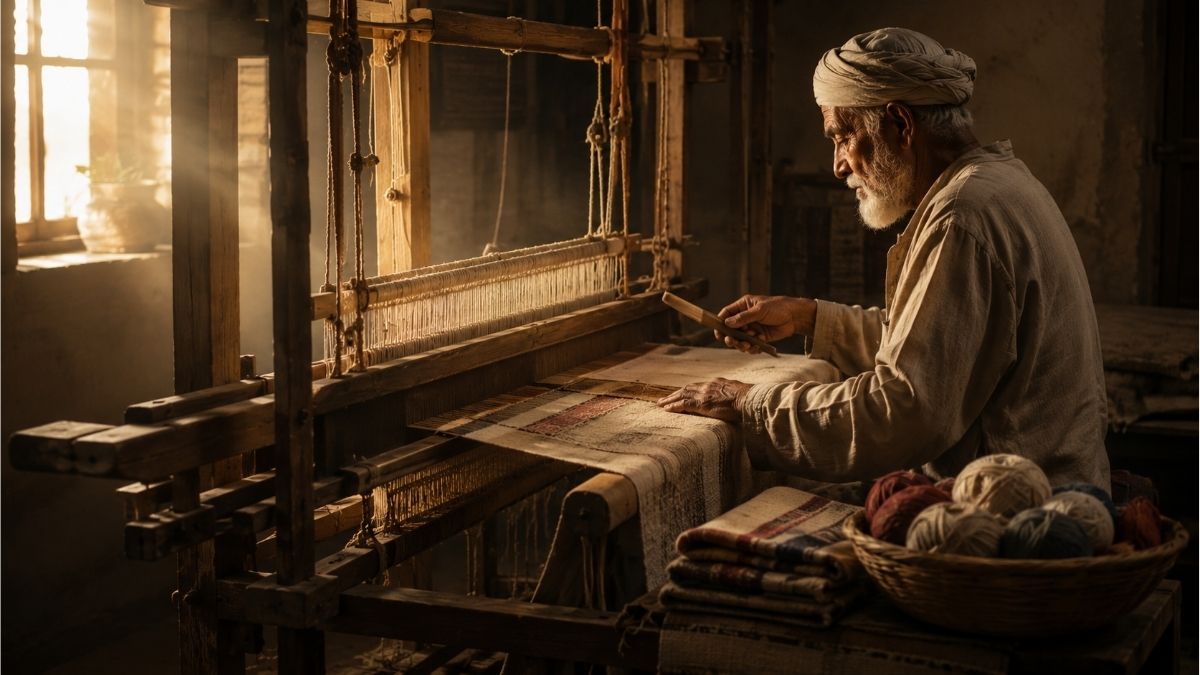
The Weaver poems are about life, work, fate, patience, faith, and hidden patterns. In these poems, weaving often becomes a symbol for how human experiences are joined together thread by thread.
What does weaving symbolize in poetry?
Weaving usually symbolizes the making of life, character, destiny, memory, or connection. A loom may suggest discipline and labor, while a thread may suggest a single life, choice, relationship, or fragile hope.
Which poem is best for the meaning of weaving and life?
The Old-Fashioned Loom is one of the strongest choices because it directly connects the loom with work, love, character, and simple living. A Noiseless Patient Spider is also powerful because it turns the spider’s thread into a symbol of the soul seeking connection.
Are these poems good for students?
Yes. These poems are useful for students because they include clear symbols, themes, and literary devices. Common discussion points include metaphor, symbolism, repetition, personification, moral lesson, and the contrast between ordinary labor and deeper meaning.
What are the main themes in poems about weaving and life?
The main themes include patience, work, memory, faith, temptation, loneliness, social hardship, human connection, and the mystery of fate. Many of these poems use thread, cloth, web, or loom imagery to show how life is gradually formed.
What is a good short poem about weaving or threads?
A Shady Friend for Torrid Days by Emily Dickinson and Fire-Flies by A. Mary F. Robinson are good short choices. Both use thread, tapestry, web, or weaving imagery to suggest hidden emotional or spiritual patterns.
Continue Reading
Related Poems & Articles
More selected reading from Inspirational Poems.