
Poetry & Analysis
Tribute Poem for Brother
Family PoemsTo My Brother
Willie Pearse
O faithful!
Moulded in one womb,
We have stood together all the years,
All the glad years and all the sorrowful years,
Own brothers: through good repute and ill,
In direst peril true to me,
Leaving all things for me, spending yourself
In the hard service that I taught to you,
Of all the men that I have known on earth,
You only have been my familiar friend,
Nor needed I another.
Overview Short Summary
Pearse speaks to his brother Willie as a faithful companion who stood beside him through joy, sorrow, danger, and sacrifice. The poem is brief, but its emotional weight is strong.
Core Ideas Main Themes
- Loyalty: The brother is praised for remaining true in both good and dangerous times.
- Shared life: “Moulded in one womb” emphasizes deep family connection.
- Brother as friend: The speaker calls his brother his only familiar friend, turning brotherhood into companionship.
Emotional Effect Tone and Mood
The tone is solemn, grateful, and direct. The mood is reverent, making it a powerful tribute poem for brother and a strong brother love poem in English.
Craft Literary Devices
- Apostrophe: The direct cry “O faithful!” gives the poem emotional force.
- Repetition: The repeated idea of “all the years” stresses long loyalty.
- Contrast: Glad years and sorrowful years show the brother’s constancy in every condition.
To My Brother
This will I do when we have peace again,
Peace and return, to ease my heart of pain.
Crouched in the brittle reed-beds, wrapt in grey,
I’ll watch the dawning of the winter’s day,
The peaceful, clinging darkness of the night
That mingles with mysterious morning light,
And graceful rushes melting in the haze;
While all around in winding waterways,
The wildfowl gabble cheerfully and low,
Or wheel with pulsing whistle to and fro,
Filling the silent down with joyous song,
Swelling and dying as they sweep along;
Till shadows of vague trees deceive the eyes,
And stealthily the sun begins to rise,
Striving to smear with pink the frosted sky,
And pierce the silver mists’ opacity;
Until the hazy silhouettes grow clear,
And faintest hints of colouring appear,
And the slow, throbbing, red, distorted sun
Reaches the sky, and all the large mists run,
Leaving the little ones to wreathe and shiver,
Pathetic, clinging to the friendly river;
Until the watchful heron, grim and gaunt,
Shows ghostlike, standing at his chosen haunt,
And jerkily the moorhens venture out,
Spreading swift-circled ripples round about,
And softly to the ear, and leisurely,
Querulous, comes the plaintive plover’s cry;
And then maybe some whispering near by,
Some still small sound as of a happy sigh,
Shall steal upon my senses soft as air,
And, brother! I shall know that you are there.
And in the lazy summer nights I’ll glide
Silently down the sleepy river’s tide,
Listening to the music of the stream,
The plop of ponderously playful bream,
The water whispering around the boat,
And from afar the white owl’s liquid note,
Lingering through the stillness soft and slow,
Watching the little yacht’s red, homely glow,
Her vague reflection, and her clean-cut spars,
Ink-black against the silverness of the stars,
Stealthily slipping into nothingness;
While on the river’s moon-splashed surfaces,
Tall shadows sweep. Then when I go to rest
It may be that my slumbers will be blessed
By the faint sound of your untroubled breath,
Proving your presence near, in spite of death.
Overview Short Summary
The speaker imagines returning to peaceful natural places after war and feeling his dead brother nearby. The poem turns memory into presence, especially through dawn, river, birds, and night sounds.
Core Ideas Main Themes
- Grief after death: The poem speaks directly to the pain of losing a brother.
- Memory and peace: Peace is imagined as the condition in which grief can finally breathe.
- Presence beyond death: The speaker believes small sounds and natural signs may prove his brother is still near.
Emotional Effect Tone and Mood
The tone is mournful, tender, and hopeful. The mood is quiet and deeply visual, making it useful for readers looking for missing my brother poem, rest in peace brother poem, or brother death anniversary poem.
Literary Technique Imagery and Symbols
The river, dawn, mist, birds, moonlight, and boat symbolize the movement from pain toward peace. The brother’s presence is not seen directly; it is felt through sound, silence, and atmosphere.
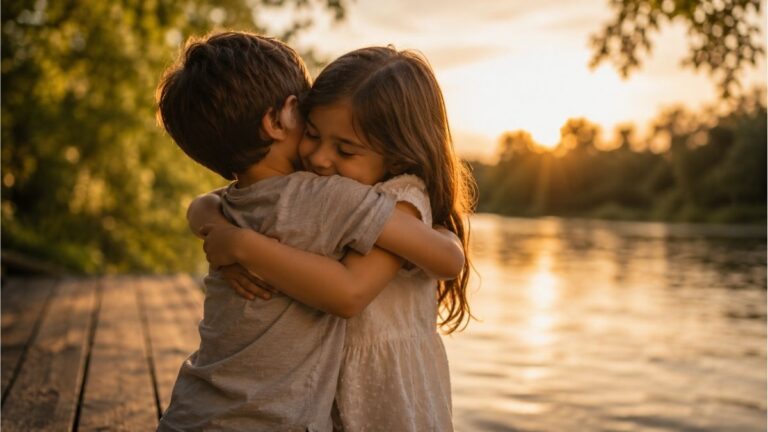
Brother and Sister
I.
I cannot choose but think upon the time
When our two lives grew like two buds that kiss
At lightest thrill from the bee’s swinging chime,
Because the one so near the other is.
He was the elder and a little man
Of forty inches, bound to show no dread,
And I the girl that puppy-like now ran,
Now lagged behind my brother’s larger tread.
I held him wise, and when he talked to me
Of snakes and birds, and which God loved the best,
I thought his knowledge marked the boundary
Where men grew blind, though angels knew the rest.
If he said “Hush!” I tried to hold my breath;
Wherever he said “Come!” I stepped in faith.
II.
Long years have left their writing on my brow,
But yet the freshness and the dew-fed beam
Of those young mornings are about me now,
When we two wandered toward the far-off stream
With rod and line. Our basket held a store
Baked for us only, and I thought with joy
That I should have my share, though he had more,
Because he was the elder and a boy.
The firmaments of daisies since to me
Have had those mornings in their opening eyes,
The bunched cowslip’s pale transparency
Carries that sunshine of sweet memories,
And wild-rose branches take their finest scent
From those blest hours of infantine content.
III.
Our mother bade us keep the trodden ways,
Stroked down my tippet, set my brother’s frill,
Then with the benediction of her gaze
Clung to us lessening, and pursued us still
Across the homestead to the rookery elms,
Whose tall old trunks had each a grassy mound,
So rich for us, we counted them as realms
With varied products: here were earth-nuts found,
And here the Lady-fingers in deep shade;
Here sloping toward the Moat the rushes grew,
The large to split for pith, the small to braid;
While over all the dark rooks cawing flew.
And made a happy strange solemnity,
A deep-toned chant from life unknown to me.
IV.
Our meadow-path had memorable spots:
One where it bridged a tiny rivulet,
Deep hid by tangled blue Forget-me-nots;
And all along the waving grasses met
My little palm, or nodded to my cheek,
When flowers with upturned faces gazing drew
My wonder downward, seeming all to speak
With eyes of souls that dumbly heard and knew.
Then came the copse, where wild things rushed unseen,
And black-scathed grass betrayed the past abode
Of mystic gypsies, who still lurked between
Me and each hidden distance of the road.
A gypsy once had startled me at play,
Blotting with her dark smile my sunny day.
V.
Thus rambling we were schooled in deepest lore,
And learned the meanings that give words a soul,
The fear, the love, the primal passionate store,
Whose shaping impulses make manhood whole.
Those hours were seed to all my after good;
My infant gladness, through eye, ear, and touch,
Took easily as warmth a various food
To nourish the sweet skill of loving much.
For who in age shall roam the earth and find
Reasons for loving that will strike out love
With sudden rod from the hard year-pressed mind?
Were reasons sown as thick as stars above,
‘T is love must see them, as the eyes see light:
Day is but Number to the darkened sight.
VI.
Our brown canal was endless to my thought;
And on its banks I sat in dreamy peace,
Unknowing how the good I loved was wrought,
Untroubled by the fear that it would cease.
Slowly the barges floated into view,
Hounding a grassy hill to me sublime
With some Unknown beyond it, whither flew
The parting cuckoo toward a fresh spring-time.
The wide-arched bridge, the scented elder-flowers,
The wondrous watery rings that died too soon,
The echoes of the quarry, the still hours
With white robe sweeping on the shadeless noon,
Were but my growing self, are part of me,
My present Past, my root of piety.
VII.
Those long days measured by my little feet
Had chronicles which yield me many a text;
Where irony still finds an image meet
Of full-grown judgments in this world perplext.
One day my brother left me in high charge,
To mind the rod, while he went seeking bait,
And bade me, when I saw a nearing barge,
Snatch out the line, lest he should come too late.
Proud of the task, I watched with all my might
For one whole minute, till my eyes grew wide,
Till sky and earth took on a strange new light
And seemed a dream-world floating on some tide
A fair pavilioned boat for me alone
Bearing me onward through the vast unknown.
VIII.
But sudden came the barge’s pitch-black prow,
Nearer and angrier came my brother’s cry,
And all my soul was quivering fear, when lo!
Upon the imperilled line, suspended high,
A silver perch! My guilt that won the prey,
Now turned to merit, had a guerdon rich
Of hugs and praises, and made merry play.
Until my triumph reached its highest pitch
When all at home were told the wondrous feat.
And how the little sister had fished well.
In secret, though my fortune tasted sweet,
I wondered why this happiness befell.
“The little lass had luck,” the gardener said:
And so I learned, luck was with glory wed.
IX.
We had the selfsame world enlarged for each
By loving difference of girl and boy:
The fruit that hung on high beyond my reach
He plucked for me, and oft he must employ
A measuring glance to guide my tiny shoe
Where lay firm stepping-stones, or call to mind
“This thing I like my sister may not do,
For she is little, and I must be kind.”
Thus boyish Will the nobler mastery learned
Where inward vision over impulse reigns,
Widening its life with separate life discerned,
A Like unlike, a Self that self restrains.
His years with others must the sweeter be
For those brief days he spent in loving me.
X.
His sorrow was my sorrow, and his joy
Sent little leaps and laughs through all my frame;
My doll seemed lifeless and no girlish toy
Had any reason when my brother came.
I knelt with him at marbles, marked his fling
Cut the ringed stem and make the apple drop,
Or watched him winding close the spiral string
That looped the orbits of the humming top.
Grasped by such fellowship my vagrant thought
Ceased with dream-fruit dream-wishes to fulfil;
My aëry-picturing fantasy was taught
Subjection to the harder, truer skill
That seeks with deeds to grave a thought-tracked line.
And by “What is,” “What will be” to define.
XI.
School parted us; we never found again
That childish world where our two spirits mingled
Like scents from varying roses that remain
One sweetness, nor can evermore be singled.
Yet the twin habit of that early time
Lingered for long about the heart and tongue:
We had been natives of one happy clime,
And its dear accent to our utterance clung.
Till the dire years whose awful name is Change
Had grasped our souls still yearning in divorce,
And pitiless shaped them in two forms that range
Two elements which sever their life’s course.
But were another childhood-world my share,
I would be born a little sister there.
Overview Short Summary
George Eliot remembers a childhood shaped by an elder brother’s presence. The poem follows shared walks, games, fears, discoveries, and the gradual separation that comes with school, time, and change.
Core Ideas Main Themes
- Brother and sister bond: The poem is one of the clearest classic poems about brother and sister love.
- Childhood memory: The speaker’s adult self returns to early scenes that still feel emotionally alive.
- Admiration for an elder brother: The brother is seen as wise, brave, protective, and central to the sister’s young world.
- Change and separation: The final section shows how life divides people who were once inseparable.
Emotional Effect Tone and Mood
The tone is nostalgic, loving, and reflective. The mood is tender but bittersweet because the childhood bond is remembered as beautiful and unrecoverable.
Close Reading Stanza-by-Stanza Explanation
Sections I–II
The speaker remembers following her elder brother with trust and admiration. Even years later, the mornings they spent together remain fresh in memory.
Sections III–IV
The siblings explore the familiar landscape of home. Trees, flowers, paths, and hidden places become part of the speaker’s emotional education.
Sections V–VI
The poem explains that those childhood experiences taught the speaker how to love deeply. The landscape becomes part of her identity.
Sections VII–VIII
A fishing memory shows childhood fear, accident, luck, praise, and wonder. The episode feels small, but it becomes a lasting lesson.
Sections IX–X
The brother protects, guides, and enlarges the sister’s world. His joys and sorrows become hers, showing how strongly their inner lives are connected.
Section XI
The poem ends with separation. School and time divide the siblings, but the speaker’s final wish is clear: if she could live childhood again, she would still choose to be a little sister.
Literary Technique Imagery and Symbols
The poem uses rich natural imagery—buds, bees, daisies, wild roses, trees, flowers, streams, and canals—to show how childhood memory grows out of place. The “little sister” becomes a symbol of trust, dependence, admiration, and early love.
Craft Literary Devices
- Simile: The opening compares the siblings’ lives to “two buds that kiss,” showing closeness and innocence.
- Imagery: Detailed outdoor scenes make memory vivid and sensory.
- Symbolism: The stream, canal, and path suggest childhood movement, discovery, and time.
- Contrast: The poem contrasts childhood unity with adult separation.
Reader Questions
Frequently Asked Questions
What are the best short poems about brothers?
Good short poems about brothers include John Keats’s “To My Brothers,” Felicia Hemans’s “To My Brother,” Isaac Watts’s “Love Between Brothers and Sisters,” and Patrick Pearse’s “To My Brother.” These poems are brief, emotional, and easy to understand.
What is a good poem for brother from sister?
Felicia Hemans’s “To My Brother” is a strong brother poem from sister because it reads like a warm blessing. George Eliot’s “Brother and Sister” is better for readers who want a deeper poem about childhood, memory, and the bond between an elder brother and little sister.
Which poems are best for a brother who passed away?
Henry David Thoreau’s “To My Brother,” Alfred Tennyson’s “Prefatory Poem to My Brother’s Sonnets,” and Miles Jeffery Game Day’s “To My Brother” are suitable for grief, remembrance, and memorial reading. They work well for searches such as brother memorial poems, poems about losing a brother, and remembering my brother poem.
What poem can I use as a tribute to my brother?
Patrick Pearse’s “To My Brother” works well as a tribute poem for brother because it focuses on loyalty, shared life, sacrifice, and friendship. For a softer tribute, Keats’s “To My Brothers” offers warmth and family closeness.
Are there classic poems about brothers and sisters?
Yes. George Eliot’s “Brother and Sister,” Felicia Hemans’s “To My Brother and Sister, in the Country,” and Isaac Watts’s “Love Between Brothers and Sisters” are classic poems about brothers and sisters. Each one approaches sibling love in a different way: memory, reunion, and family peace.
Which poem is suitable for an elder brother or younger brother?
For an elder brother, Felicia Hemans’s “To My Eldest Brother” is especially suitable because it honors an older brother with pride and affection. For a younger brother, “To My Younger Brother on His Entering the Army” carries encouragement, love, and family concern.
Continue Reading
Related Poems & Articles
More selected reading from Family Poems.