
Public-Domain Christian Nativity Poetry
Poems About the Holy Night in Bethlehem
Christian Poems About JesusThe Christmas Silence
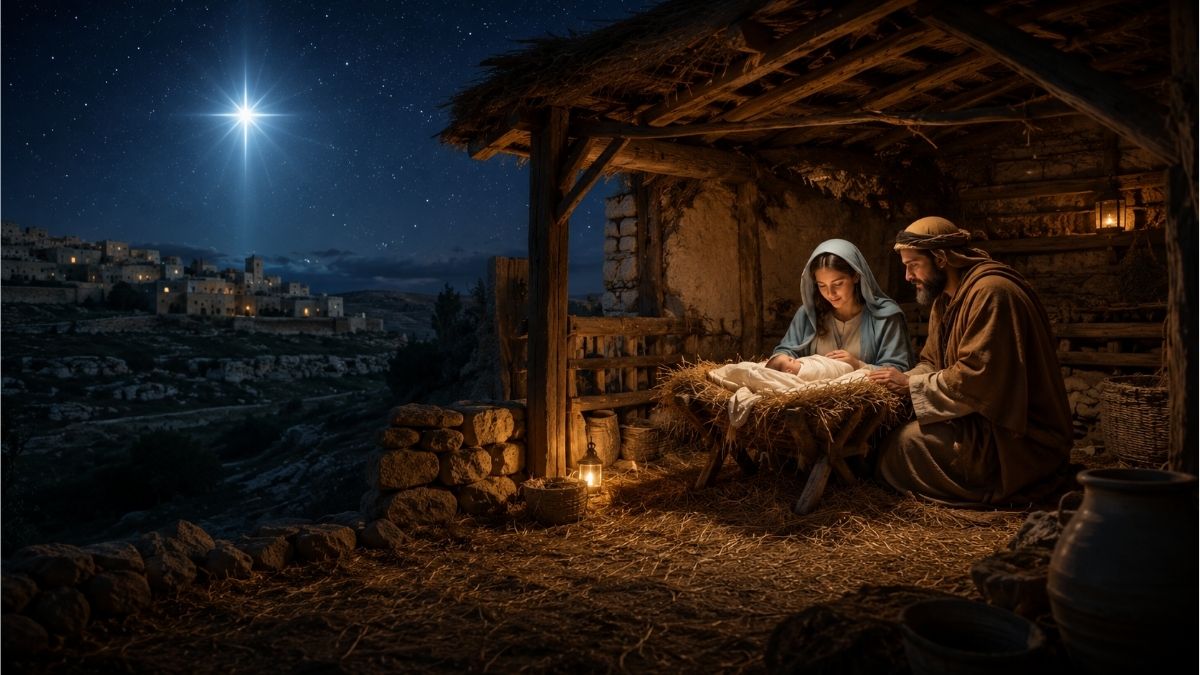
Hushed are the pigeons cooing low
On dusty rafters of the loft;
And mild-eyed oxen, breathing soft,
Sleep on the fragrant hay below.
Dim shadows in the corner hide;
The glimmering lantern’s rays are shed
Where one young lamb just lifts his head,
Then huddles ‘gainst his mother’s side.
Strange silence tingles in the air;
Through the half-open door a bar
Of light from one low-hanging star
Touches a baby’s radiant hair.
No sound: the mother, kneeling, lays
Her cheek against the little face.
Oh human love! Oh heavenly grace!
‘Tis yet in silence that she prays!
Ages of silence end to-night;
Then to the long-expectant earth
Glad angels come to greet His birth
In burst of music, love, and light!
Overview Short Summary
The stable rests in deep silence until angels break the stillness with music, love, and light.
Faith Reflection Christian Meaning and Reflection
The poem imagines the intimate quiet around Mary and Jesus before the public announcement. Human tenderness and heavenly grace meet in the same scene.
Core Ideas Main Themes
- Holy silence: The stable is pictured as still and expectant.
- Mary and Jesus: The mother’s closeness gives the scene human warmth.
- Angelic announcement: Silence gives way to praise.
Scriptural Context Biblical Connection
Luke 2:7 presents the manger, while Luke 2:9–14 describes the glory and song of the angels.
Reader Application Best Use
Best for Christmas Eve, candlelight worship, Mary-and-child readings, or a reflective Nativity program.
Close Reading Stanza-by-Stanza Explanation
Stanzas 1–3
Animals, shadows, lantern light, and the star create the quiet stable scene.
Stanza 4
Mary’s prayer joins human love with heavenly grace.
Stanza 5
The angelic song ends the long silence.
Poetic Technique Imagery and Literary Devices
Sound imagery moves from hush to music, while light gradually enters the dark stable.
A Christmas Lullaby
Sleep, baby, sleep! The Mother sings:
Heaven’s angels kneel and fold their wings.
Sleep, baby, sleep!
With swathes of scented hay Thy bed
By Mary’s hand at eve was spread.
Sleep, baby, sleep!
At midnight came the shepherds, they
Whom seraphs wakened by the way.
Sleep, baby, sleep!
And three kings from the East afar,
Ere dawn came, guided by the star.
Sleep, baby, sleep!
They brought Thee gifts of gold and gems,
Pure orient pearls, rich diadems.
Sleep, baby, sleep!
Thou who liest slumbering there,
Art King of Kings, earth, ocean, air.
Sleep, baby, sleep!
Sleep, baby, sleep! The shepherds sing:
Through heaven, through earth, hosannas ring.
Sleep, baby, sleep!
Overview Short Summary
Mary sings over the sleeping child while shepherds, angels, and kings gather around the King of Kings.
Faith Reflection Christian Meaning and Reflection
The lullaby holds together Jesus’ vulnerability and majesty. He sleeps on hay as a baby while heaven and earth recognize His kingship.
Core Ideas Main Themes
- Mary’s care: The mother prepares the child’s simple bed.
- Manger: The humble setting remains central.
- Divine kingship: The sleeping infant is named King of Kings.
Scriptural Context Biblical Connection
Luke 2:7–20 describes Mary, the manger, and shepherds. Matthew 2:1–11 provides the later visit of the Magi.
Reader Application Best Use
Suitable for children, Christmas Eve, a Mary-and-Jesus section, Nativity recitation, or a gentle church program.
Poetic Technique Imagery and Literary Devices
The repeated lullaby refrain creates tenderness and unifies the scenes of Mary, shepherds, angels, and kings.
Hymn for the Nativity
Happy night and happy silence downward softly stealing,
Softly stealing over land and sea,
Stars from golden censors swing a silent eager feeling
Down on Judah, down on Galilee;
And all the wistful air, and earth, and sky,
Listened, listened for the gladness of a cry.
Holy night, a sudden flash of light its way is winging:
Angels, angels, all above, around;
Hark, the angel voices, hark, the angel voices singing;
And the sheep are lying on the ground.
Lo, all the wistful air, and earth, and sky,
Listen, listen to the gladness of the cry.
Happy night at Bethlehem; soft little hands are feeling,
Feeling in the manger with the kine:
Little hands, and eyelids closed in sleep, while angels kneeling,
Mary mother, hymn the Babe Divine.
Lo, all the wistful air, and earth, and sky,
Listen, listen to the gladness of the cry.
Wide, as if the light were music, flashes adoration:
“Glory be to God, nor ever cease,”
All the silence thrills, and speeds the message of salvation:
“Peace on earth, good-will to men of peace.”
Lo, all the wistful air, and earth, and sky,
Listen, listen to the gladness of the cry.
Holy night, thy solemn silence evermore enfoldeth
Angels songs and peace from God on high:
Holy night, thy watcher still with faithful eye beholdeth
Wings that wave, and angel glory nigh,
Lo, hushed is strife in air, and earth, and sky,
Still thy watchers hear the gladness of the cry.
Praise Him, ye who watch the night, the silent night of ages:
Praise Him, shepherds, praise the Holy Child;
Praise Him, ye who hear the light, O praise Him, all ye sages;
Praise Him, children, praise Him meek and mild.
Lo, peace on Earth, glory to God on high,
Listen, listen to the gladness of the cry.
Overview Short Summary
The hymn moves from Bethlehem’s silence to angelic light, the manger, Mary, shepherds, praise, salvation, and peace.
Faith Reflection Christian Meaning and Reflection
This is one of the clearest poetic retellings of Luke 2. The child’s cry becomes the center of a cosmic response involving earth, sky, angels, shepherds, and worshippers.
Core Ideas Main Themes
- Luke 2: Manger, angels, sheep, shepherds, and peace shape the poem.
- Salvation: The birth is presented as a saving message.
- Universal praise: Children, shepherds, and sages are called to worship.
Scriptural Context Biblical Connection
Luke 2:1–20 is the primary source, especially the manger sign and the angelic words about glory and peace.
Reader Application Best Use
Excellent for a church Christmas program, Scripture-and-poetry reading, Nativity service, or Luke 2 lesson.
Close Reading Stanza-by-Stanza Explanation
Stanzas 1–2
Expectant silence is interrupted by angelic light and song.
Stanzas 3–4
The manger scene is linked to salvation and peace.
Stanzas 5–6
The event becomes continuing worship for shepherds, sages, and children.
Poetic Technique Imagery and Literary Devices
Repetition of listening, light-as-music imagery, refrain, and personification of air, earth, and sky create a large-scale Nativity scene.
Masters in This Hall
“To Bethlem did they go, the shepherds three;
To Bethlem did they go to see whe’r it were so or no,
Whether Christ were born or no
To set men free.”
Masters, in this hall,
Hear ye news to-day
Brought over sea,
And ever I you pray.
Nowell! Nowell! Nowell! Nowell!
Sing we clear!
Holpen are all folk on earth,
Born is God’s Son so dear.
Going over the hills,
Through the milk-white snow,
Heard I ewes bleat
While the wind did blow.
Nowell, &c.
Shepherds many an one
Sat among the sheep;
No man spake more word
Than they had been asleep.
Nowell, &c.
Quoth I ‘Fellows mine,
Why this guise sit ye?
Making but dull cheer,
Shepherds though ye be?
Nowell, &c.
‘Shepherds should of right
Leap and dance and sing;
Thus to see ye sit
Is a right strange thing.’
Nowell, &c.
Quoth these fellows then
‘To Bethlem town we go,
To see a Mighty Lord
Lie in manger low.’
Nowell, &c.
‘How name ye this Lord,
Shepherds?’ then said I.
‘Very God’ they said,
‘Come from Heaven high.’
Nowell, &c.
Then to Bethlem town
We went two and two,
And in a sorry place
Heard the oxen low.
Nowell, &c.
Therein did we see
A sweet and goodly May,
And a fair old man;
Upon the straw she lay.
Nowell, &c.
And a little CHILD
On her arm had she;
‘Wot ye who this is?’
Said the hinds to me.
Nowell, &c.
Ox and ass him know,
Kneeling on their knee:
Wondrous joy had I
This little BABE to see.
Nowell, &c.
This is CHRIST the Lord,
Masters, be ye glad!
Christmas is come in,
And no folk should be sad.
Nowell, &c.
Overview Short Summary
A lively narrator joins shepherds travelling to Bethlehem, where they find Mary, Joseph, and the child lying in a humble place.
Faith Reflection Christian Meaning and Reflection
The poem works especially well as a recitation because it tells the Bethlehem story through dialogue, movement, refrain, and joyful announcement.
Core Ideas Main Themes
- Journey to Bethlehem: The shepherds go to verify the angelic news.
- Manger humility: The Mighty Lord lies in a poor place.
- Joyful proclamation: The refrain invites the audience to celebrate.
Scriptural Context Biblical Connection
Luke 2:15–20 describes the shepherds going to Bethlehem, finding the child, and making the message known.
Reader Application Best Use
Ideal for church Christmas programs, group recitation, Sunday school, children’s performance, or a traditional carol section.
Poetic Technique Imagery and Literary Devices
Dialogue, refrain, repetition, archaic diction, and a first-person journey make the narrative vivid and performable.
The Adoration of the Wise Men
Saw you never in the twilight,
When the sun had left the skies,
Up in heaven the clear stars shining,
Through the gloom like silver eyes?
So of old the wise men watching,
Saw a little stranger star,
And they knew the King was given,
And they follow’d it from far.
Heard you never of the story,
How they cross’d the desert wild,
Journey’d on by plain and mountain,
Till they found the Holy Child?
How they open’d all their treasure,
Kneeling to that Infant King,
Gave the gold and fragrant incense,
Gave the myrrh in offering?
Know ye not that lowly Baby
Was the bright and morning star,
He who came to light the Gentiles,
And the darken’d isles afar?
And we too may seek his cradle,
There our heart’s best treasures bring,
Love, and Faith, and true devotion,
For our Saviour, God, and King.
Overview Short Summary
The Wise Men follow a strange star, cross the desert, find the child, and offer gifts and worship.
Faith Reflection Christian Meaning and Reflection
The poem connects the Magi’s gifts with the reader’s response. Gold and incense give way to love, faith, and true devotion.
Core Ideas Main Themes
- Magi: The Wise Men seek the newborn King.
- Star: A heavenly sign guides the journey.
- Worship and gifts: The child receives treasure and devotion.
Scriptural Context Biblical Connection
Matthew 2:1–12 tells of the Magi, the star, their journey, worship, and gifts. This visit belongs to Matthew’s narrative rather than Luke’s shepherd scene.
Reader Application Best Use
Suitable for Epiphany, Wise Men programs, gift-themed lessons, or explaining the difference between Luke 2 and Matthew 2.
Continue Reading
Related Poems & Articles
More selected reading from Christian Poems About Jesus.