Introduction
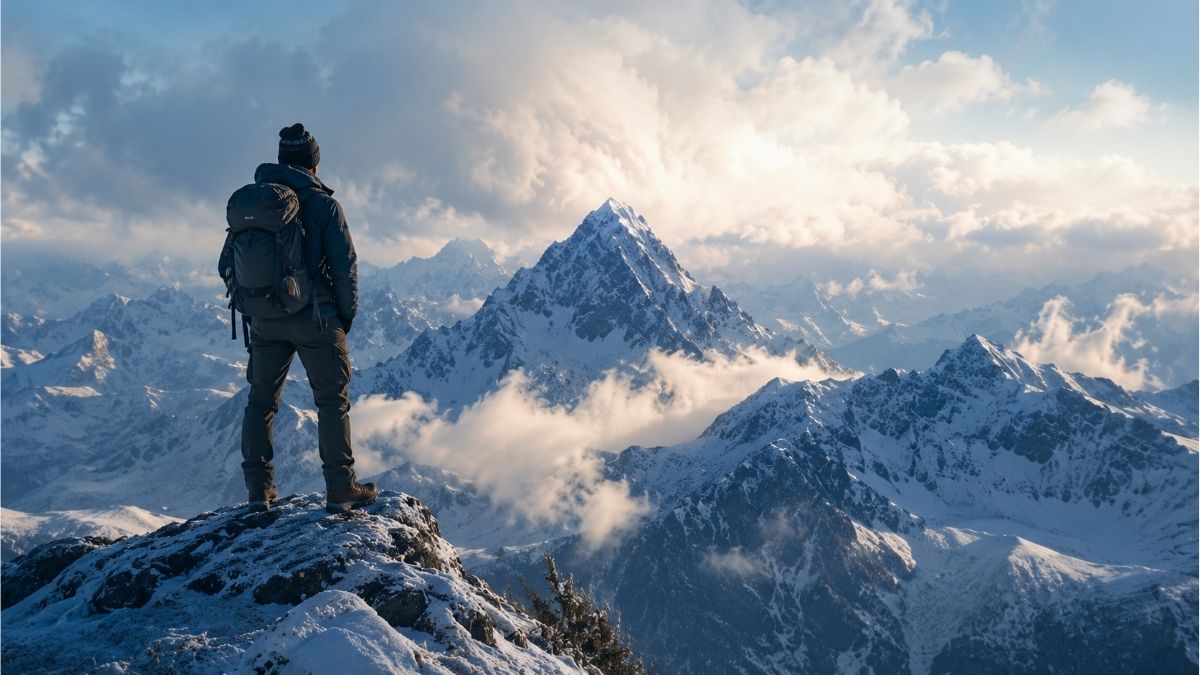
Mountains enter poetry as more than scenery. A ridge can hold the memory of home, a snow line can suggest silence, and a steep path can become a figure for endurance, grief, faith, or hope. This collection brings together mountain poems about strength, solitude, snow, sunrise, remembrance, and the difficult upward journey.
Readers looking for short mountain poems that rhyme, snowy mountain poems, mountain poems for kids, funeral poems for mountain lovers, or poems about overcoming mountains will find each selection followed by a concise explanation of its meaning and most relevant themes. For more writing centered on courage, renewal, and inner strength, explore these Inspirational Poems.
Poetry & Analysis
Short Mountain Poems That Rhyme
Nature PoemsFable
The mountain and the squirrel
Had a quarrel;
And the former called the latter “Little Prig.”
Bun replied,
“You are doubtless very big;
But all sorts of things and weather
Must be taken in together,
To make up a year
And a sphere.
And I think it no disgrace
To occupy my place.
If I’m not so large as you,
You are not so small as I,
And not half so spry.
I’ll not deny you make
A very pretty squirrel track;
Talents differ; all is well and wisely put;
If I cannot carry forests on my back,
Neither can you crack a nut.”
Overview Short Summary
A mountain and a squirrel compare their abilities. The squirrel accepts the mountain’s size but reminds it that every creature has a different purpose and talent.
Core Ideas Main Themes
- Individual worth: Value does not depend on size, power, or status.
- Different abilities: The mountain and squirrel are useful in completely different ways.
- Self-respect: The squirrel refuses to feel inferior simply because it is small.
Style Tone and Literary Devices
The tone is playful and confident. Personification turns the mountain and squirrel into speakers, while rhyme makes the poem memorable for younger readers.
The Eagle
He clasps the crag with crooked hands;
Close to the sun in lonely lands,
Ring’d with the azure world, he stands.
The wrinkled sea beneath him crawls;
He watches from his mountain walls,
And like a thunderbolt he falls.
Overview Short Summary
An eagle stands high on a mountain crag, looking down over the distant sea before diving with sudden and overwhelming force.
Core Ideas Main Themes
- Strength and command: The eagle appears powerful, watchful, and completely at home above the world.
- Mountain solitude: Height separates the bird from ordinary life below.
- Sudden action: Stillness gives way to a lightning-fast descent.
Literary Technique Imagery and Sound
The crag, sun, blue sky, and distant sea create sharp visual scale. Alliteration in “clasps,” “crag,” and “crooked” strengthens the eagle’s grip, while the thunderbolt simile gives the final line explosive speed.
The Mountain
The mountain sat upon the plain
In his eternal chair,
His observation omnifold,
His inquest everywhere.
The seasons prayed around his knees,
Like children round a sire:
Grandfather of the days is he,
Of dawn the ancestor.
Overview Short Summary
Dickinson presents the mountain as an ancient seated ruler whose height allows it to watch the land while seasons and dawn gather around it like descendants.
Core Ideas Main Themes
- Endurance: The mountain appears older and more lasting than changing seasons.
- Authority: Its elevated position gives it the dignity of a patriarch or judge.
- Time: The mountain becomes a witness to repeated dawns and generations of days.
Craft Literary Devices
Extended personification transforms the mountain into a seated elder. The family imagery of children, sire, grandfather, and ancestor makes geological age feel intimate and understandable.
Up-Hill
Does the road wind up-hill all the way?
Yes, to the very end.
Will the day’s journey take the whole long day?
From morn to night, my friend.
But is there for the night a resting-place?
A roof for when the slow dark hours begin.
May not the darkness hide it from my face?
You cannot miss that inn.
Shall I meet other wayfarers at night?
Those who have gone before.
Then must I knock, or call when just in sight?
They will not keep you standing at that door.
Shall I find comfort, travel-sore and weak?
Of labour you shall find the sum.
Will there be beds for me and all who seek?
Yea, beds for all who come.
Overview Short Summary
A traveler asks whether the upward road will remain difficult and whether rest waits at the end. Each answer acknowledges the long climb but promises shelter, companionship, and welcome.
Core Ideas Main Themes
- Perseverance: The road requires a full day of steady effort.
- Hope after hardship: Rest is certain even when the destination cannot yet be seen.
- Spiritual journey: The inn and earlier travelers suggest death, heaven, or final peace.
Poetic Form Structure and Meaning
The poem is written as a question-and-answer dialogue. Its repeated pattern balances human uncertainty with calm reassurance, making the upward road a clear metaphor for life’s struggle.
Upon the Mountain’s Distant Head
Upon the mountain’s distant head,
With trackless snows for ever white,
Where all is still, and cold, and dead,
Late shines the day’s departing light.
But far below those icy rocks,
The vales, in summer bloom arrayed,
Woods full of birds, and fields of flocks,
Are dim with mist and dark with shade.
’Tis thus, from warm and kindly hearts,
And eyes where generous meanings burn,
Earliest the light of life departs,
But lingers with the cold and stern.
Overview Short Summary
The last sunlight remains on a cold, snow-covered summit after the warmer valleys have darkened. Bryant uses the contrast to make a reflective statement about life and character.
Core Ideas Main Themes
- Snow-covered mountains: The summit is remote, still, and permanently white.
- Warmth and coldness: The physical landscape becomes a comparison between generous and stern hearts.
- Mortality: Departing light suggests the fading of life.
Interpretation Contrast and Symbolism
The warm valley and frozen summit form the poem’s central contrast. Light symbolizes life, while the lingering glow on the cold peak creates the poem’s unsettling final paradox.
Continue Reading
Related Poems & Articles
More selected reading from Nature Poems.