Poetry & Analysis
Selected Hummingbird Poems
Animal PoemsThe Hummingbird
When langourous noons entreat the summer sky,
And restive spirits vex the ways of men
In vain emprise; within my garden then
Will I elect to let the world go by,
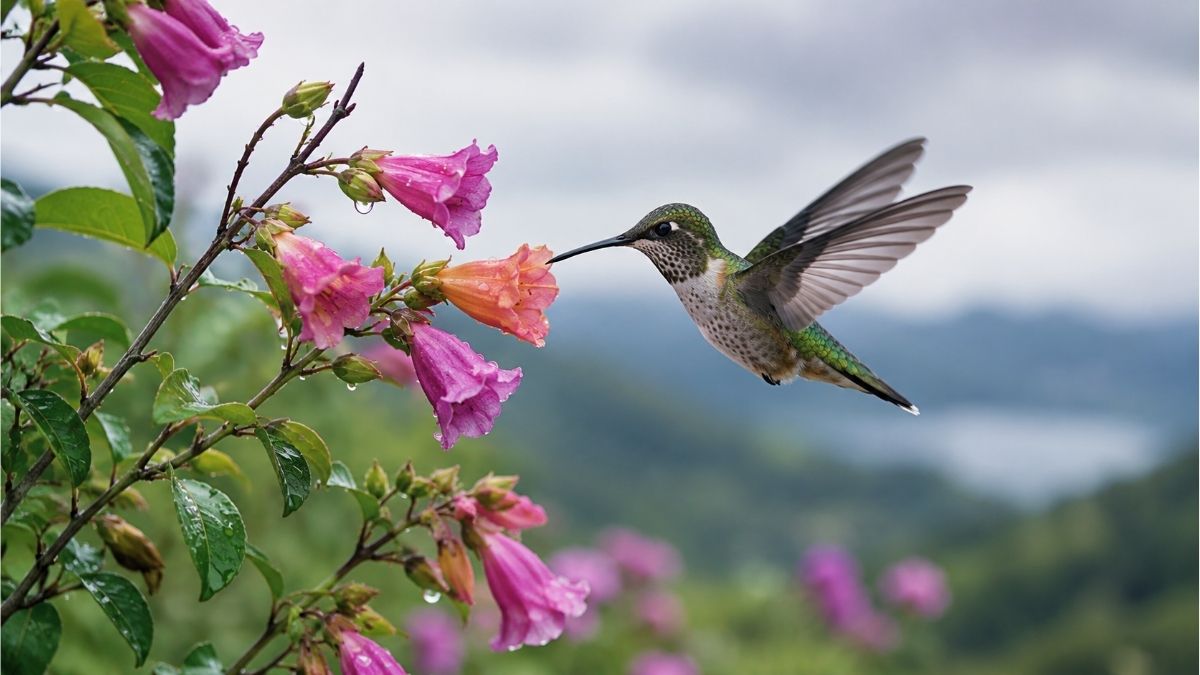
And watch the hummingbird. Not seen to fly,
He comes and vanishes and comes again
And sips the sweets of honeysuckles when
Their lips are frail―but leaves them not to die.
So I have thought how good it were to be
This ruthful corsair, bent on such pursuit,
Against the wear of my foreplanning hours;―
How good it were to live thus liegelessly
Upon the world’s unreckoned blossom-loot―
Yet spare from any harm its guarded flowers!
Overview Short Summary
Ivan Swift’s “The Hummingbird” is a reflective garden poem. The speaker watches the bird as a model of free, harmless desire: it takes sweetness from flowers but leaves them unharmed.
Core Ideas Main Themes
- Garden escape: Watching the hummingbird lets the speaker step away from restless human concerns.
- Freedom: The bird lives “liegelessly,” outside human planning.
- Gentle desire: It sips sweetness but spares the flowers.
- Nature as healing: The garden scene calms the speaker’s vexed spirit.
Emotional Effect Tone and Mood
The tone is reflective, calm, and admiring. The mood is peaceful because the bird offers release from human restlessness.
Interpretation Animal Symbolism
The hummingbird symbolizes free joy, harmless appetite, and a lighter way of living. It teaches the speaker a less anxious relationship with desire.
Close Reading Stanza-by-Stanza Explanation
Stanza 1
The speaker turns away from the restless world and watches the hummingbird in the garden, where it appears and vanishes among honeysuckles.
Stanza 2
The speaker wishes to live like the hummingbird: free, unburdened, and able to take sweetness without harming flowers.
Literary Technique Imagery and Personification
The poem uses summer-noon, garden, honeysuckle, frail lips, sweetness, and blossom-loot imagery. Personification appears in the honeysuckles’ “lips” and guarded flowers.
Craft Literary Devices
- Metaphor: The bird is called a “ruthful corsair,” a gentle pirate of flowers.
- Personification: Flowers have lips and guarded vulnerability.
- Contrast: Human restlessness contrasts with the bird’s free motion.
- Symbolism: The hummingbird represents harmless joy and freedom.
Poetic Form Rhyme Scheme and Structure
The poem is a sonnet-like lyric with two major movements: observation and reflection. Its structure turns a garden sight into a life lesson.
To a Ruby-Throated Humming-Bird
Aristocrat of birds (thy summer spent
Near Arctic snows, thy winter passed beside
The tropic seas thou and thy dainty bride),
How thou must scorn the zone where we are pent.
Fearless darter through the blue firmament,
I bid thee hail, and here denounce the pride
That in man’s heart, like Caliban, doth hide,
Whilst thou upon thy Ariel quests art bent.
Alas! for all the cravings of the soul,
We only in imagination soar,
Only in dreams we taste ambrosial sweets;
But thou, O bird, commander of thy goal,
Dost quaff thy wine within the bright retreats
Of joy, and fold thy wings at Beauty’s door.
Overview Short Summary
Laura Blackburn’s “To a Ruby-Throated Humming-Bird” praises the bird as an aristocrat of birds, a fearless traveler, and a creature that reaches the joy humans only imagine.
Core Ideas Main Themes
- Freedom and migration: The bird travels between northern and tropical regions.
- Joy: It drinks from bright retreats of joy.
- Human limitation: Humans only dream of the freedom the bird lives.
- Beauty: The bird folds its wings at Beauty’s door.
Emotional Effect Tone and Mood
The tone is elevated, admiring, and slightly envious. The mood is aspirational because the bird lives the freedom humans long for.
Interpretation Animal Symbolism
The ruby-throated hummingbird symbolizes freedom, beauty, spiritual aspiration, and the ability to reach joy directly.
Close Reading Stanza-by-Stanza Explanation
Octave
The opening eight lines praise the bird’s travel, aristocratic quality, fearless flight, and Ariel-like quests.
Sestet
The final six lines compare the bird’s real freedom with human dreams and cravings. The bird reaches joy and beauty more fully than humans can.
Literary Technique Imagery and Personification
The poem uses imagery of Arctic snows, tropic seas, blue firmament, Ariel, ambrosial sweets, wine, joy, and Beauty’s door. Personification appears in Beauty as a place with a door.
Craft Literary Devices
- Allusion: Caliban and Ariel refer to Shakespeare’s The Tempest.
- Apostrophe: The speaker directly addresses the bird.
- Contrast: Human limitation contrasts with bird freedom.
- Symbolism: Beauty’s door symbolizes access to spiritual joy.
Poetic Form Rhyme Scheme and Structure
The poem is sonnet-like, with octave and sestet movement. It begins with praise and turns toward human longing.
The Humming-Bird
The humming-bird! the humming-bird!
So fairy-like and bright:
It lives among the sunny flowers,
A creature of delight!
In the radiant islands of the East,
Where fragrant spices grow,
A thousand, thousand humming-birds
Go glancing to and fro.
Like living fires they flit about,
Scarce larger than a bee,
Among the broad palmetto leaves,
And through the fan-palm tree.
And in those wild and verdant woods,
Where stately mosses tower,
Where hangs from branching tree to tree
The scarlet passion flower;
Where on the mighty river banks,
La Plate and Amazon,
The cayman, like an old tree trunk,
Lies basking in the sun;
There builds her nest the humming-bird,
Within the ancient wood –
Her nest of silky cotton down –
And rears her tiny brood.
She hangs it to a slender twig,
Where waves it light and free,
As the campanero tolls his song,
And rocks the mighty tree.
All crimson is her shining breast,
Like to the red, red rose;
Her wing is the changeful green and blue
That the neck of the peacock shows.
Thou, happy, happy humming-bird,
No winter round thee lours;
Thou never saw’st a leafless tree,
Nor land without sweet flowers.
A reign of summer joyfulness
To thee for life is given;
Thy food, the honey from the flower,
Thy drink, the dew from heaven!
Overview Short Summary
Mary Howitt’s “The Humming-Bird” is a bright descriptive poem that imagines hummingbirds in warm lands of flowers, spice, forests, rivers, nests, and endless summer.
Core Ideas Main Themes
- Delight: The hummingbird is called “a creature of delight.”
- Summer joy: The bird lives in a world of flowers, dew, honey, and warmth.
- Motherhood and nest: The poem describes the hummingbird building a small nest and rearing a brood.
- Color and beauty: Crimson, green, blue, and rose imagery dominate the poem.
Emotional Effect Tone and Mood
The tone is joyful, descriptive, and admiring. The mood is bright and exotic because the poem imagines a flower-rich world without winter.
Interpretation Animal Symbolism
The hummingbird symbolizes delight, summer, delicate motherhood, and a life sustained by flowers and heaven’s dew.
Close Reading Stanza-by-Stanza Explanation
Opening Stanzas
The poem introduces the hummingbird as fairy-like, bright, and living among sunny flowers.
Middle Stanzas
The bird is placed in radiant, tropical landscapes of spices, palms, passion flowers, rivers, and forest life.
Nest Stanzas
The poem shifts to the hummingbird’s nest and tiny brood, presenting the bird as a careful mother.
Closing Stanzas
The poem praises the bird’s color and happy summer life, fed by flower honey and dew.
Literary Technique Imagery and Personification
The poem uses rich nature imagery: sunny flowers, fragrant spices, living fires, palmetto leaves, passion flowers, rivers, silky cotton nest, crimson breast, and heavenly dew. Personification appears when winter is imagined as something that could “lour” over a land.
Craft Literary Devices
- Repetition: “The humming-bird!” and “happy, happy” emphasize delight.
- Simile: The bird is like living fire and its breast like a red rose.
- Imagery: The poem is full of tropical flower and color imagery.
- Symbolism: The bird represents joy and endless summer.
Poetic Form Rhyme Scheme and Structure
The poem uses regular rhymed quatrains. Its structure moves from general praise, to landscape, to nesting, to final blessing.
Humming Bird
Humming Bird, the dainty thing,
Has no voice and cannot sing,
He lives daintily, and sips
Honey from the flowers’ lips.
Overview Short Summary
This short children’s poem presents the hummingbird as a delicate creature that does not sing but lives by sipping honey from flowers.
Core Ideas Main Themes
- Small beauty: The bird is described as dainty.
- Flower relationship: The hummingbird feeds from the flowers’ “lips.”
- Silence: The poem notes that the bird has no singing voice.
Emotional Effect Tone and Mood
The tone is simple, gentle, and child-friendly. The mood is sweet because the poem presents one clear image of delicate feeding.
Interpretation Animal Symbolism
The hummingbird symbolizes delicate life and quiet beauty. It also shows that a bird does not need a song to seem charming.
Close Reading Stanza-by-Stanza Explanation
Single Stanza
The poem gives a brief portrait of the hummingbird: small, silent, and living delicately by sipping from flowers.
Literary Technique Imagery and Personification
The poem uses imagery of a dainty bird, honey, and flowers’ lips. Personification appears when flowers are given lips.
Craft Literary Devices
- Personification: Flowers are given lips.
- Contrast: The bird lacks song but still has charm.
- Imagery: Honey and flowers create sweetness.
- Conciseness: The poem creates a complete image in four lines.
Poetic Form Rhyme Scheme and Structure
The poem is a four-line children’s rhyme. Its simple form makes it useful for hummingbird poem for kids and short hummingbird poem intent.
Humming-Bird
I can imagine, in some otherworld
Primeval-dumb, far back
In that most awful stillness, that only gasped and hummed,
Humming-birds raced down the avenues.
Before anything had a soul,
While life was a heave of Matter, half inanimate,
This little bit chipped off in brilliance
And went whizzing through the slow, vast, succulent stems.
I believe there were no flowers, then
In the world where the humming-bird flashed ahead of creation.
I believe he pierced the slow vegetable veins with his long beak.
Probably he was big
As mosses, and little lizards, they say, were once big.
Probably he was a jabbing, terrifying monster.
We look at him through the wrong end of the long telescope of Time,
Luckily for us.
Overview Short Summary
D. H. Lawrence’s “Humming-Bird” imagines the bird in a prehistoric world before flowers. Instead of seeing the hummingbird as merely delicate, Lawrence imagines it as ancient, brilliant, and even terrifying.
Core Ideas Main Themes
- Primeval imagination: The poem places hummingbirds before ordinary creation.
- Brilliance and speed: The bird is a “little bit chipped off in brilliance.”
- Reversal of scale: Lawrence imagines the tiny modern bird as once large and monstrous.
- Time and perception: The telescope image suggests humans misunderstand the past.
Emotional Effect Tone and Mood
The tone is imaginative, strange, and awe-filled. The mood is prehistoric and unsettling because the hummingbird becomes both beautiful and terrifying.
Interpretation Animal Symbolism
The hummingbird symbolizes ancient energy, creative force, and beauty seen through the distortion of time. It is not only a garden jewel but a flash ahead of creation.
Close Reading Stanza-by-Stanza Explanation
Stanza 1
The speaker imagines an ancient world of stillness and humming where hummingbirds race through avenues.
Stanza 2
The bird is described as brilliance chipped from matter, moving through slow, succulent stems.
Stanza 3
The speaker imagines a time before flowers, when the hummingbird pierced vegetable veins with its beak.
Stanzas 4–5
The poem then imagines the hummingbird as once large and terrifying. The final telescope image explains that modern humans see it from the wrong end of time.
Literary Technique Imagery and Personification
The poem uses primeval imagery, brilliance, slow stems, vegetable veins, long beak, giant mosses, lizards, and a telescope of time. Personification is limited; the bird is instead mythologized as a prehistoric force.
Craft Literary Devices
- Metaphor: The hummingbird is “chipped off in brilliance.”
- Imagery: Primeval stillness and vegetable veins create a strange ancient world.
- Hyperbole: The tiny bird is imagined as a terrifying monster.
- Perspective shift: The telescope metaphor changes how readers see size and time.
Poetic Form Rhyme Scheme and Structure
The poem uses free verse with uneven stanza lengths. Its structure moves from imagined origin, to prehistoric feeding, to a final reversal of perspective.
Critical Reading AP Lit-Style Central Argument
Lawrence uses prehistoric imagery, scale reversal, and the metaphor of the telescope of time to transform the hummingbird from a delicate modern creature into a symbol of ancient creative violence and brilliance.
Reader Questions
Frequently Asked Questions
What are hummingbird poems usually about?
Hummingbird poems are usually about beauty, speed, joy, flowers, light, hope, memory, delicate life, and the surprise of seeing something tiny move with extraordinary energy.
What does a hummingbird symbolize in poetry?
In poetry, a hummingbird often symbolizes joy, hope, healing, spiritual lightness, quick beauty, renewal, and the fragile power of small living things.
What is a good short hummingbird poem?
Emily Dickinson’s “The Humming-Bird,” Hilda Conkling’s “Humming-Bird,” Edwin Markham’s “The Humming Bird,” and the short children’s poem “Humming Bird” are good choices for short hummingbird poem searches.
Why are hummingbirds connected with hope and healing?
Hummingbirds appear suddenly, move lightly, and feed among flowers, so readers often connect them with renewal, joy, spiritual messages, and small moments of comfort after difficulty.
Which hummingbird poems are good for children?
Simple poems such as “Humming Bird” from Bird Children, Hilda Conkling’s “Humming-Bird,” and short descriptive poems about flowers and wings work well for children because they use clear images and gentle language.
Can hummingbird poems be used for cards or memorial messages?
Yes. Short hummingbird poems can work well for greeting cards, garden cards, memorial notes, or sympathy messages because the bird is often associated with love, hope, memory, and spiritual comfort.
Continue Reading
Related Poems & Articles
More selected reading from Animal Poems.