Complete Poem, Meaning & Allusions
Edgar Allan Poe Romantic Poems
Featured PoemsTo Helen
Helen, thy beauty is to me
Like those Nicéan barks of yore,
That gently, o’er a perfumed sea,
The weary, way-worn wanderer bore
To his own native shore.
On desperate seas long wont to roam,
Thy hyacinth hair, thy classic face,
Thy Naiad airs have brought me home
To the glory that was Greece,
And the grandeur that was Rome.
Lo! in yon brilliant window-niche
How statue-like I see thee stand,
The agate lamp within thy hand!
Ah, Psyche, from the regions which
Are Holy Land!
Overview To Helen Summary and Meaning
The speaker compares Helen’s beauty with ancient ships carrying a tired traveller home. Her appearance provides emotional and imaginative refuge, leading him from dangerous seas towards an ideal world associated with classical Greece and Rome.
The poem’s central idea is that beauty can restore a person who feels spiritually displaced. Helen is not described only as an attractive individual; she becomes a guide towards harmony, culture and sacred feeling.
Classical Allusion Nicean Barks Meaning
“Barks” are sailing vessels. The Nicéan barks represent ships from the ancient Mediterranean world carrying a tired traveller back to his native shore. By comparing Helen’s beauty with those ships, the speaker suggests that her presence gives him safety, orientation and a sense of homecoming.
Interpretation Classical Allusions in To Helen
- Helen: The name recalls Helen of Troy and the classical ideal of extraordinary beauty.
- Hyacinth hair: The phrase suggests rich, classically beautiful hair and may also recall the flower and Greek myth.
- Naiad airs: Naiads were water nymphs, linking Helen with grace and the ancient world.
- The glory that was Greece: Greece represents beauty, art, philosophy and cultural achievement.
- The grandeur that was Rome: Rome represents power, order and magnificence.
- Psyche: Psyche means soul and also names a figure from classical mythology.
- The lamp: The lamp suggests illumination, guidance and sacred presence.
Poetic Craft Rhyme Scheme and Literary Devices
The poem has three five-line stanzas. Its rhyme varies, but the controlled musical pattern supports the sense of graceful movement and homecoming.
- Simile: Helen’s beauty is compared with ships carrying a wanderer home.
- Metaphor: Emotional restoration becomes a sea journey towards a native shore.
- Allusion: Classical references enlarge Helen from an individual into an ideal.
- Visual imagery: Hair, face, statue, window and lamp create a composed portrait.
- Elevated diction: Archaic language helps create distance from ordinary contemporary life.
Ulalume
The skies they were ashen and sober;
The leaves they were crispèd and sere—
The leaves they were withering and sere;
It was night in the lonesome October
Of my most immemorial year;
It was hard by the dim lake of Auber,
In the misty mid region of Weir—
It was down by the dank tarn of Auber,
In the ghoul-haunted woodland of Weir.
Here once, through an alley Titanic,
Of cypress, I roamed with my Soul—
Of cypress, with Psyche, my Soul.
These were days when my heart was volcanic
As the scoriac rivers that roll—
As the lavas that restlessly roll
Their sulphurous currents down Yaanek
In the ultimate climes of the pole—
That groan as they roll down Mount Yaanek
In the realms of the boreal pole.
Our talk had been serious and sober,
But our thoughts they were palsied and sere—
Our memories were treacherous and sere—
For we knew not the month was October,
And we marked not the night of the year—
Ah, night of all nights in the year!
We noted not the dim lake of Auber—
Though once we had journeyed down here—
Remembered not the dank tarn of Auber,
Nor the ghoul-haunted woodland of Weir.
And now, as the night was senescent,
And star-dials pointed to morn—
As the sun-dials hinted of morn—
At the end of our path a liquescent
And nebulous lustre was born,
Out of which a miraculous crescent
Arose with a duplicate horn—
Astarte’s bediamonded crescent
Distinct with its duplicate horn.
And I said—“She is warmer than Dian:
She rolls through an ether of sighs—
She revels in a region of sighs:
She has seen that the tears are not dry on
These cheeks, where the worm never dies,
And has come past the stars of the Lion
To point us the path to the skies—
To the Lethean peace of the skies—
Come up, in despite of the Lion,
To shine on us with her bright eyes—
Come up through the lair of the Lion,
With love in her luminous eyes.”
But Psyche, uplifting her finger,
Said—“Sadly this star I mistrust—
Her pallor I strangely mistrust:—
Oh, hasten!—oh, let us not linger!
Oh, fly!—let us fly!—for we must.”
In terror she spoke, letting sink her
Wings until they trailed in the dust—
In agony sobbed, letting sink her
Plumes till they trailed in the dust—
Till they sorrowfully trailed in the dust.
I replied—“This is nothing but dreaming:
Let us on by this tremulous light!
Let us bathe in this crystalline light!
Its Sibyllic splendor is beaming
With Hope and in Beauty to-night:—
See!—it flickers up the sky through the night!
Ah, we safely may trust to its gleaming,
And be sure it will lead us aright—
We safely may trust to a gleaming
That cannot but guide us aright,
Since it flickers up to Heaven through the night.”
Thus I pacified Psyche and kissed her,
And tempted her out of her gloom—
And conquered her scruples and gloom;
And we passed to the end of a vista,
But were stopped by the door of a tomb—
By the door of a legended tomb;
And I said—“What is written, sweet sister,
On the door of this legended tomb?”
She replied—“Ulalume—Ulalume—
’Tis the vault of thy lost Ulalume!”
Then my heart it grew ashen and sober
As the leaves that were crispèd and sere—
As the leaves that were withering and sere;
And I cried—“It was surely October
On this very night of last year
That I journeyed—I journeyed down here—
That I brought a dread burden down here!
On this night of all nights in the year,
Ah, what demon has tempted me here?
Well I know, now, this dim lake of Auber—
This misty mid region of Weir—
Well I know, now, this dank tarn of Auber,
This ghoul-haunted woodland of Weir.”
Overview Ulalume Summary and Meaning
The speaker walks at night with Psyche, the personification of his own soul. Neither consciously remembers that the path leads towards the tomb of Ulalume, a woman he buried there exactly one year earlier.
A bright celestial figure appears to promise hope, but Psyche warns against following it. The speaker ignores that warning and reaches the grave, where buried memory returns with full force. The poem suggests that grief may guide a person unconsciously towards what the conscious mind has tried to forget.
Symbolism Astarte and Psyche in Ulalume
- Psyche: Psyche represents the speaker’s soul, intuition or inward awareness. She senses danger before his conscious mind understands it.
- Astarte: Astarte is associated with love and the evening star. Her light appears hopeful but leads towards renewed grief.
- Dian: Diana represents a colder and more restrained lunar presence, contrasted with Astarte’s apparently warmer light.
- The Lion: The constellation Leo becomes part of the celestial path the speaker interprets as guidance.
- Lethean peace: Lethe was the river of forgetfulness; the phrase suggests the speaker’s desire to escape memory.
Setting Lake of Auber and Woodland of Weir Meaning
The lake, tarn and woodland are imaginative Gothic locations rather than realistic geography. Their repeated names make the landscape feel ritualistic and enclosed. Cypress trees, dead leaves, mist and October connect the setting with burial, decay and returning memory.
Poetic Craft Repetition, Sound and Gothic Atmosphere
- Repetition: Whole phrases return with slight changes, imitating memory that refuses to stay buried.
- Internal rhyme: Dense sound patterns make the poem feel incantatory.
- Personification: The speaker’s soul becomes Psyche, a separate companion with her own warnings.
- Allusion: Classical and mythological names create a symbolic landscape of love, memory and death.
- Colour imagery: Ashen skies and pale light drain warmth from the setting.
- Circular structure: The walk unknowingly returns the speaker to the place of his earlier grief.
The Haunted Palace
In the greenest of our valleys
By good angels tenanted,
Once a fair and stately palace—
Radiant palace—reared its head.
In the monarch Thought’s dominion—
It stood there!
Never seraph spread a pinion
Over fabric half so fair!
Banners yellow, glorious, golden,
On its roof did float and flow,
(This—all this—was in the olden
Time long ago),
And every gentle air that dallied,
In that sweet day,
Along the ramparts plumed and pallid,
A wingèd odor went away.
Wanderers in that happy valley,
Through two luminous windows, saw
Spirits moving musically,
To a lute’s well-tunèd law,
Round about a throne, where sitting
Porphyrogene!
In state his glory well befitting,
The ruler of the realm was seen.
And all with pearl and ruby glowing
Was the fair palace door,
Through which came flowing, flowing, flowing,
And sparkling evermore,
A troop of Echoes, whose sweet duty
Was but to sing,
In voices of surpassing beauty,
The wit and wisdom of their king.
But evil things, in robes of sorrow,
Assailed the monarch’s high estate;
Ah, let us mourn!—for never morrow
Shall dawn upon him desolate!
And, round about his home, the glory
That blushed and bloomed
Is but a dim-remembered story
Of the old time entombed.
And travellers now within that valley,
Through the red-litten windows see
Vast forms that move fantastically
To a discordant melody;
While, like a ghastly rapid river,
Through the pale door
A hideous throng rush out forever,
And laugh—but smile no more.
Overview The Haunted Palace Summary and Meaning
The poem first describes a beautiful palace ruled by a wise monarch. Light shines from its windows, music moves within it, and its doorway releases expressions of intelligence and beauty.
After “evil things” attack, the palace becomes dark and disordered. Its windows turn red, its music becomes discordant, and hideous forms replace the earlier harmony. The change presents the destruction of a once-ordered mind.
Allegory The Palace as a Symbol of the Mind
- The palace: The building represents the human mind or head.
- The monarch Thought: The king represents reason and conscious control.
- The two windows: The luminous and later red-lit windows represent the eyes.
- The palace door: The doorway represents the mouth.
- The echoes: The beautiful voices represent intelligent and harmonious speech.
- The hideous throng: The final forms represent disordered thoughts or expressions.
- Discordant music: The broken melody represents the collapse of mental harmony.
Poetic Craft Contrast and Structural Transformation
The poem is built around a clear before-and-after structure. The first four stanzas establish beauty and order; the last two describe invasion and decay.
- Extended allegory: Every architectural feature contributes to the representation of a mind.
- Colour imagery: Gold, pearl and ruby give way to red and pale surfaces.
- Repetition: “Flowing” conveys effortless expression before the palace’s decline.
- Personification: The palace appears to live, communicate and suffer.
- Musical contrast: A well-tuned lute is replaced by discordant melody.
The Conqueror Worm
Lo! ’tis a gala night
Within the lonesome latter years!
An angel throng, bewinged, bedight
In veils, and drowned in tears,
Sit in a theatre, to see
A play of hopes and fears,
While the orchestra breathes fitfully
The music of the spheres.
Mimes, in the form of God on high,
Mutter and mumble low,
And hither and thither fly—
Mere puppets they, who come and go
At bidding of vast formless things
That shift the scenery to and fro,
Flapping from out their Condor wings
Invisible Wo!
That motley drama—oh, be sure
It shall not be forgot!
With its Phantom chased for evermore,
By a crowd that seize it not,
Through a circle that ever returneth in
To the self-same spot,
And much of Madness, and more of Sin,
And Horror the soul of the plot.
But see, amid the mimic rout,
A crawling shape intrude!
A blood-red thing that writhes from out
The scenic solitude!
It writhes!—it writhes!—with mortal pangs
The mimes become its food,
And the angels sob at vermin fangs
In human gore imbued.
Out—out are the lights—out all!
And, over each quivering form,
The curtain, a funeral pall,
Comes down with the rush of a storm,
While the angels, all pallid and wan,
Uprising, unveiling, affirm
That the play is the tragedy, “Man,”
And its hero, the Conqueror Worm.
Overview The Conqueror Worm Summary and Meaning
Angels watch a theatrical performance in which humanlike actors move as puppets, chase an unreachable phantom and repeatedly return to the same place. A blood-red worm eventually enters, consumes the performers and ends the show.
The final stanza explains the allegory: the play is human life, and the worm is death. The title is deliberately unsettling because death, rather than a heroic human figure, becomes the only certain conqueror.
Allegory Life as a Play in The Conqueror Worm
- The theatre: The theatre represents the world in which human life unfolds.
- The mimes: The actors represent human beings.
- The unseen forces: The formless beings controlling the scenery suggest fate or powers beyond human control.
- The phantom: The unreachable figure may represent hope, meaning or desire.
- The circle: Repeated movement suggests human patterns that fail to reach a final earthly solution.
- The worm: The worm represents death and bodily decay.
- The curtain: The funeral-pall curtain represents the end of life.
Poetic Craft Tone and Literary Devices
The tone is theatrical, grim and fatalistic. The apparent celebration of a “gala night” is immediately disturbed by weeping angels and a drama controlled by invisible forces.
- Extended metaphor: Human life is presented as a stage performance.
- Irony: A festive theatrical event becomes a tragedy of death.
- Personification: The worm receives the heroic title “Conqueror.”
- Colour imagery: Blood-red emphasizes physical death and horror.
- Repetition: “It writhes” and “out” accelerate the final destruction.
- Allusion: “Music of the spheres” refers to the ancient idea of cosmic harmony, which contrasts with the suffering on stage.
The Raven
Once upon a midnight dreary, while I pondered, weak and weary,
Over many a quaint and curious volume of forgotten lore—
While I nodded, nearly napping, suddenly there came a tapping,
As of some one gently rapping, rapping at my chamber door.
“’Tis some visitor,” I muttered, “tapping at my chamber door—
Only this and nothing more.”
Ah, distinctly I remember it was in the bleak December;
And each separate dying ember wrought its ghost upon the floor.
Eagerly I wished the morrow;—vainly I had sought to borrow
From my books surcease of sorrow—sorrow for the lost Lenore—
For the rare and radiant maiden whom the angels name Lenore—
Nameless here for evermore.
And the silken, sad, uncertain rustling of each purple curtain
Thrilled me—filled me with fantastic terrors never felt before;
So that now, to still the beating of my heart, I stood repeating
“’Tis some visitor entreating entrance at my chamber door—
Some late visitor entreating entrance at my chamber door;—
This it is and nothing more.”
Presently my soul grew stronger; hesitating then no longer,
“Sir,” said I, “or Madam, truly your forgiveness I implore;
But the fact is I was napping, and so gently you came rapping,
And so faintly you came tapping—tapping at my chamber door,
That I scarce was sure I heard you”—here I opened wide the door;—
Darkness there and nothing more.
Deep into that darkness peering, long I stood there wondering, fearing,
Doubting, dreaming dreams no mortal ever dared to dream before;
But the silence was unbroken, and the stillness gave no token,
And the only word there spoken was the whispered word, “Lenore?”
This I whispered, and an echo murmured back the word, “Lenore!”—
Merely this and nothing more.
Back into the chamber turning, all my soul within me burning,
Soon again I heard a tapping somewhat louder than before.
“Surely,” said I, “surely that is something at my window lattice;
Let me see, then, what thereat is, and this mystery explore—
Let my heart be still a moment and this mystery explore;—
’Tis the wind and nothing more!”
Open here I flung the shutter, when, with many a flirt and flutter,
In there stepped a stately Raven of the saintly days of yore;
Not the least obeisance made he; not a minute stopped or stayed he;
But, with mien of lord or lady, perched above my chamber door—
Perched upon a bust of Pallas just above my chamber door—
Perched, and sat, and nothing more.
Then this ebony bird beguiling my sad fancy into smiling,
By the grave and stern decorum of the countenance it wore,
“Though thy crest be shorn and shaven, thou,” I said, “art sure no craven,
Ghastly grim and ancient Raven wandering from the Nightly shore—
Tell me what thy lordly name is on the Night’s Plutonian shore!”
Quoth the Raven “Nevermore.”
Much I marvelled this ungainly fowl to hear discourse so plainly,
Though its answer little meaning—little relevancy bore;
For we cannot help agreeing that no living human being
Ever yet was blessed with seeing bird above his chamber door—
Bird or beast upon the sculptured bust above his chamber door,
With such name as “Nevermore.”
But the Raven, sitting lonely on the placid bust, spoke only
That one word, as if his soul in that one word he did outpour.
Nothing farther then he uttered—not a feather then he fluttered—
Till I scarcely more than muttered “Other friends have flown before—
On the morrow he will leave me, as my Hopes have flown before.”
Then the bird said “Nevermore.”
Startled at the stillness broken by reply so aptly spoken,
“Doubtless,” said I, “what it utters is its only stock and store,
Caught from some unhappy master whom unmerciful Disaster
Followed fast and followed faster till his songs one burden bore—
Till the dirges of his Hope that melancholy burden bore
Of ‘Never—nevermore.’”
But the Raven still beguiling all my fancy into smiling,
Straight I wheeled a cushioned seat in front of bird, and bust and door;
Then, upon the velvet sinking, I betook myself to linking
Fancy unto fancy, thinking what this ominous bird of yore—
What this grim, ungainly, ghastly, gaunt and ominous bird of yore
Meant in croaking “Nevermore.”
This I sat engaged in guessing, but no syllable expressing
To the fowl whose fiery eyes now burned into my bosom’s core;
This and more I sat divining, with my head at ease reclining
On the cushion’s velvet lining that the lamplight gloated o’er,
But whose velvet-violet lining with the lamplight gloating o’er,
She shall press, ah, nevermore!
Then, methought, the air grew denser, perfumed from an unseen censer
Swung by Seraphim whose foot-falls tinkled on the tufted floor.
“Wretch,” I cried, “thy God hath lent thee—by these angels he hath sent thee—
Respite—respite and nepenthe from thy memories of Lenore;
Quaff, oh quaff this kind nepenthe and forget this lost Lenore!”
Quoth the Raven “Nevermore.”
“Prophet!” said I, “thing of evil!—prophet still, if bird or devil!—
Whether Tempter sent, or whether tempest tossed thee here ashore,
Desolate yet all undaunted, on this desert land enchanted—
On this home by Horror haunted—tell me truly, I implore—
Is there—is there balm in Gilead?—tell me—tell me, I implore!”
Quoth the Raven “Nevermore.”
“Prophet!” said I, “thing of evil!—prophet still, if bird or devil!
By that Heaven that bends above us—by that God we both adore—
Tell this soul with sorrow laden if, within the distant Aidenn,
It shall clasp a sainted maiden whom the angels name Lenore—
Clasp a rare and radiant maiden whom the angels name Lenore.”
Quoth the Raven “Nevermore.”
“Be that word our sign of parting, bird or fiend!” I shrieked, upstarting—
“Get thee back into the tempest and the Night’s Plutonian shore!
Leave no black plume as a token of that lie thy soul hath spoken!
Leave my loneliness unbroken!—quit the bust above my door!
Take thy beak from out my heart, and take thy form from off my door!”
Quoth the Raven “Nevermore.”
And the Raven, never flitting, still is sitting, still is sitting
On the pallid bust of Pallas just above my chamber door;
And his eyes have all the seeming of a demon’s that is dreaming,
And the lamplight o’er him streaming throws his shadow on the floor;
And my soul from out that shadow that lies floating on the floor
Shall be lifted—nevermore!
Overview The Raven Summary and Meaning
Late at night, a grieving student hears tapping and allows a raven into his room. The bird settles on a bust above the door and answers every question with the same word: “Nevermore.”
The speaker initially treats the bird with curiosity and humour, but gradually asks increasingly painful questions about forgetting Lenore, healing from sorrow and meeting her after death. Because he already knows the bird’s only answer, his questioning becomes a form of emotional self-punishment.
Close Reading Stanza-by-Stanza Overview
Stanzas 1–3
The setting is established at midnight in bleak December. The speaker is tired, alone and trying unsuccessfully to distract himself from grief.
Stanzas 4–6
He opens the door, finds only darkness and whispers Lenore’s name. A second sound leads him towards the window.
Stanzas 7–9
The raven enters and perches on the bust of Pallas. Its strange dignity briefly amuses the speaker before it says “Nevermore.”
Stanzas 10–12
The speaker realizes the bird probably knows only one word, yet he begins attaching personal meaning to it.
Stanzas 13–15
Memory of Lenore returns. The speaker asks whether he can forget his grief and whether any spiritual healing exists.
Stanzas 16–18
He asks whether he will meet Lenore after death. The repeated negative answer drives him into anger, but the raven remains and becomes an image of permanent sorrow.
Key Symbol What Does Nevermore Mean in The Raven?
At first, “Nevermore” may simply be a word learned by the bird from a previous owner. Its emotional power comes from the speaker, who repeatedly places it beside questions about abandonment, healing and reunion.
The word eventually represents finality: Lenore will not return, grief cannot be undone, and the speaker believes his soul will not escape the raven’s shadow.
Interpretation The Raven and Bust of Pallas Symbolism
- The raven: The bird develops into a symbol of unending remembrance, grief and the finality of loss.
- The bust of Pallas: Pallas Athena represents wisdom and reason. The raven sitting above her suggests grief overpowering the speaker’s rational mind.
- Lenore: Lenore represents the lost beloved and the idealized past.
- Midnight: Midnight marks a threshold between days and creates psychological uncertainty.
- December: The final month of the year suggests ending, death and emotional coldness.
- The chamber: The enclosed room reflects the speaker’s isolated mental world.
- The shadow: The final shadow represents grief that has taken permanent possession of his consciousness.
Critical Reading Is the Narrator of The Raven Unreliable?
The narrator accurately reports some ordinary events, but his interpretation becomes increasingly shaped by grief, exhaustion and deliberate self-torment. He understands that the raven probably repeats a learned word, yet continues asking questions designed to produce painful answers.
His unreliability does not mean that nothing occurs. It means readers should distinguish the physical bird from the supernatural and emotional meaning the speaker assigns to it.
Poetic Craft Rhyme Scheme, Meter and Sound Devices
The poem’s lines are largely based on trochaic octameter, with variations and shortened refrain lines. Its musical effect depends on dense internal rhyme as much as end rhyme.
- Internal rhyme: Pairs such as “dreary” and “weary,” “napping” and “tapping,” or “sorrow” and “morrow” create continuous echo.
- Refrain: “Nevermore” changes meaning as the speaker’s questions become more serious.
- Alliteration: Phrases such as “weak and weary” or “doubting, dreaming dreams” intensify sound.
- Onomatopoeia: “Tapping” and “rapping” imitate the sounds that begin the action.
- Personification: Night, disaster, hope and memory behave like active forces.
- Gothic imagery: Darkness, dying embers, purple curtains, angels, demons and shadows create psychological unease.
Reader Questions
Frequently Asked Questions About Edgar Allan Poe Poems
What are Edgar Allan Poe's most famous poems?
Poe’s best-known poems include “The Raven,” “Annabel Lee,” “Alone,” “A Dream Within a Dream,” “The Bells,” “Eldorado,” “To Helen,” “Ulalume,” “The Haunted Palace” and “The Conqueror Worm.”
Why is Edgar Allan Poe considered a Gothic poet?
Poe repeatedly uses isolated settings, supernatural uncertainty, death, psychological disturbance, decaying places and narrators overwhelmed by fear or grief. His Gothic atmosphere usually develops from both the setting and the speaker’s unstable inner experience.
What themes appear in Edgar Allan Poe's poetry?
Recurring themes include lost love, grief, death, memory, loneliness, beauty, dreams, mental instability, the limits of reason and the difficulty of separating reality from imagination.
What does the kingdom by the sea mean in Annabel Lee?
The kingdom creates a distant, legendary setting removed from ordinary life. It represents the private emotional world shared by the speaker and Annabel Lee, while the surrounding sea suggests both depth and separation.
What does All I loved I loved alone mean?
The line expresses emotional isolation. The speaker’s strongest loves and deepest responses were not shared in the same way by other people, leaving him inwardly separate even when he was not physically alone.
What do the grains of sand symbolize in A Dream Within a Dream?
The grains symbolize moments, hopes or parts of life that cannot be permanently held. Their movement through the speaker’s fingers shows the limits of human control over time and loss.
What does Eldorado symbolize?
Eldorado symbolizes an ideal goal—wealth, fulfilment, knowledge, artistic perfection or spiritual meaning. Its distant location suggests that the search may shape a life even when the goal remains unreachable.
What are the four types of bells in The Bells?
The poem moves through silver sleigh bells, golden wedding bells, brazen alarm bells and iron funeral bells. They represent merriment, happiness, terror and death.
What does Nicean barks mean in To Helen?
The phrase refers to ancient sailing ships. Poe compares Helen’s beauty with vessels that carry a tired traveller safely home across a perfumed sea.
What does Astarte symbolize in Ulalume?
Astarte represents an apparently hopeful and attractive light associated with love. The speaker trusts her brightness, but it leads him back towards the tomb and the grief his conscious mind had forgotten.
What does the palace symbolize in The Haunted Palace?
The palace symbolizes the human mind. Its ruler represents thought, its windows represent eyes, and its doorway represents the mouth. Its decline depicts the collapse of reason and mental harmony.
What does the worm symbolize in The Conqueror Worm?
The worm symbolizes death and physical decay. By calling it the “Conqueror,” Poe presents mortality as the force that ultimately defeats every performer in the drama of human life.
Why does the raven say Nevermore?
The bird probably learned a single word from a previous owner. The speaker gives that word its increasing emotional importance by asking questions about Lenore, healing and the afterlife that can all receive the same negative answer.
Why is the raven sitting on the bust of Pallas?
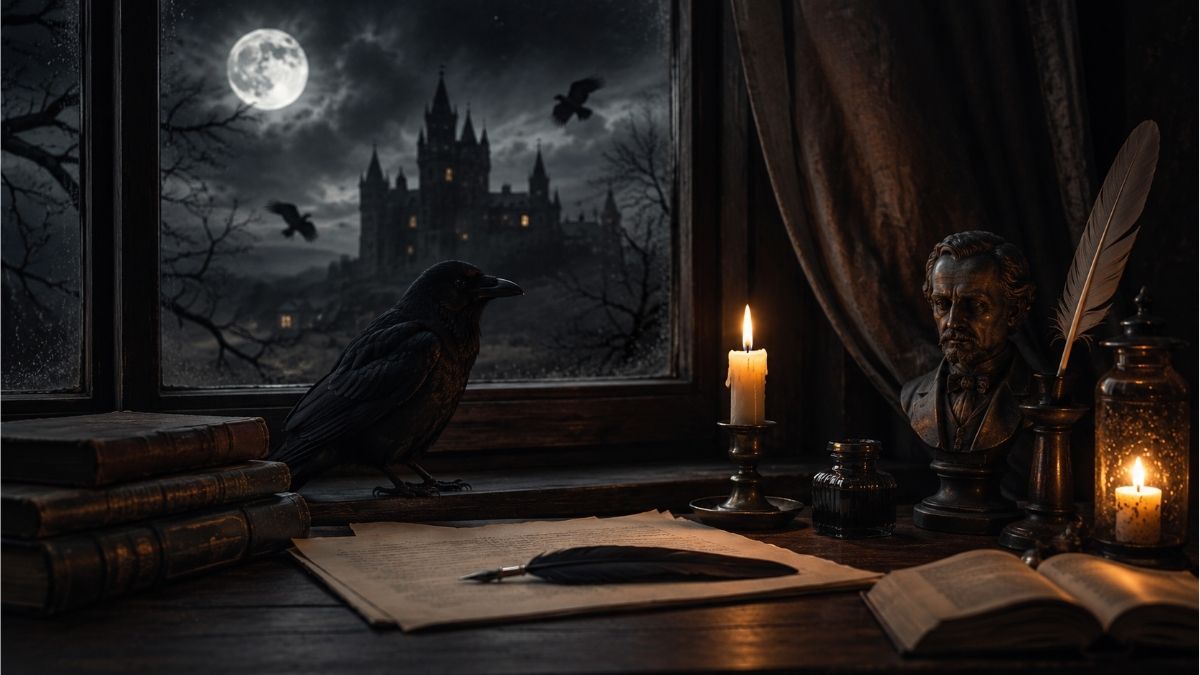
Pallas Athena represents wisdom. By placing the dark bird above her image, Poe creates a visual contrast in which grief, irrational fear and obsessive memory appear to dominate the speaker’s reason.
Are Edgar Allan Poe's poems public domain?
Edgar Allan Poe died in 1849, and the original English texts of his poems are public domain worldwide. Modern translations, recordings, illustrations, edited notes and newly created adaptations may have separate copyright protection.
Continue Reading
Related Poems & Articles
More selected reading from Featured Poems.